Inside Saudi Arabia's Female-Led Tech Boom
The article highlights a surge of female leadership reshaping Saudi Arabia’s tech sector across AI, cybersecurity, telecoms and digital government, with women occupying senior roles in startups, corporates and policy bodies. Notable names include leaders at Humain, STC Group and PurePerformance, and public initiatives that support talent and AI development.
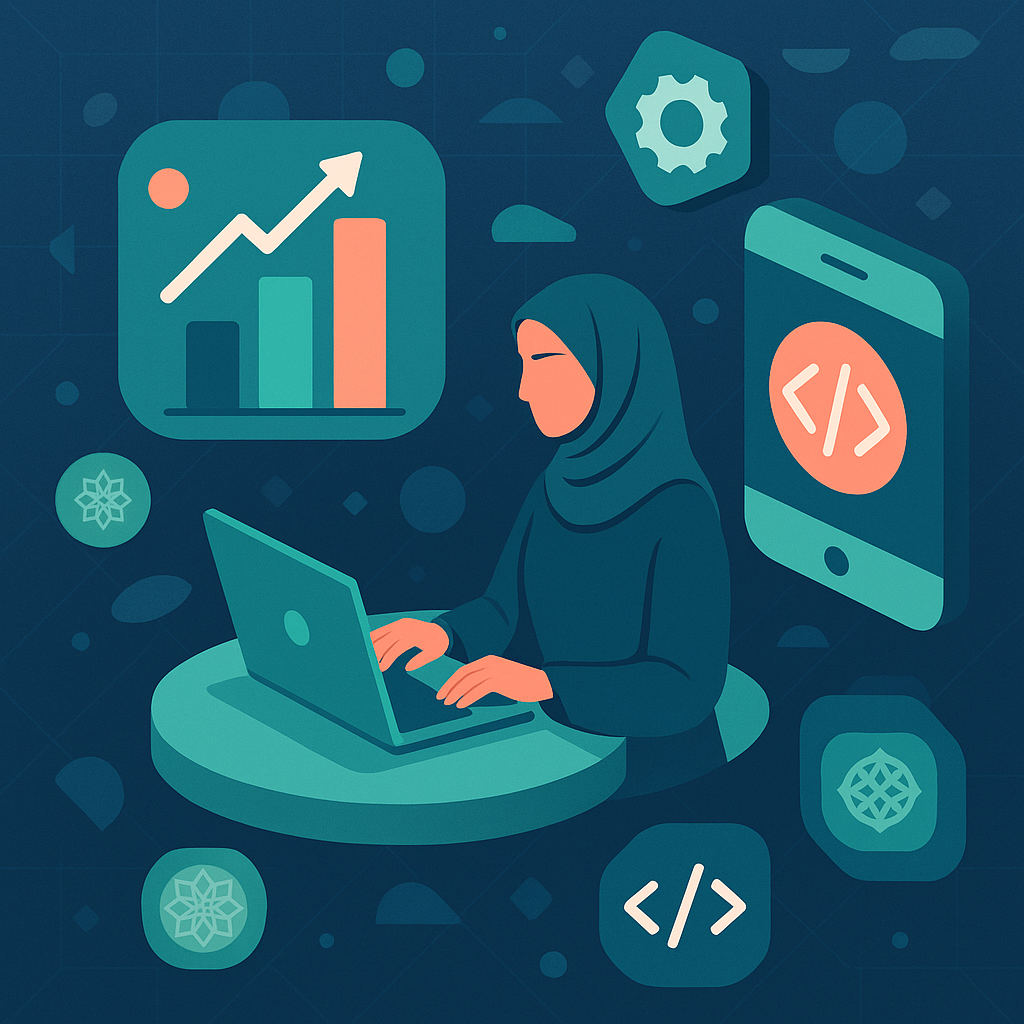
Saudi Arabia’s technology sector is being reshaped by a visible wave of female leadership across AI, cybersecurity, telecommunications, digital government and venture capital. As of September 2025 roughly 389,000 people worked in the national tech industry, and women accounted for 35% of that workforce, Safa AlRashed, assistant deputy minister for future skills and jobs at the Ministry of Communications and Information Technology, told industry audiences — a participation rate the government highlights as significantly higher than many international peers (the UK stood at 22% in December 2025, per BCS).
“My work sits at the intersection of strategy and innovation, building the digital direction of an organisation reshaping how Saudi Arabia lives and works,” says HRH Princess Maha Al Saud, who leads emerging technology for one of the Kingdom’s major giga-project developers and oversees AI, big data and PropTech rollouts aimed at simplifying customer experience and optimising operations.
High-level appointments illustrate the trend: Deemah AlYahya is secretary-general of the Digital Cooperation Organization; Mona Almehaid is vice president at Humain, the AI company backed by the Public Investment Fund; and Moudhi Al Jamea serves as vice president of STC Group and heads its innovation centre. Alongside senior executives, a new cohort of engineers, coders and researchers — many educated at King Abdullah University of Science and Technology (KAUST) and Princess Nourah bint Abdulrahman University — are returning home after overseas study to build specialised capabilities.
- Research and policy: The Saudi Data and Artificial Intelligence Authority (SDAIA) has forged partnerships with Nvidia and Google Cloud and supports programmes such as the Microsoft AI Academy to grow technical talent and industry readiness.
- Industry applications: At KAUST, researchers use AI to monitor reef health and guide coral restoration in the Red Sea; Aramco and Humain are developing Arabic-first AI models tailored to regional language and culture.
- Supporting ecosystem: Scholarship programmes, the Misk Foundation and The Garage have been cited as important enablers of female participation in technology and innovation.
“We are moving towards creating homegrown intellectual property and experiences that can travel internationally while remaining connected to local identity. That shift is incredibly exciting to be part of,” says Sara Bou-Holaigah, who leads cultural innovation and immersive storytelling at a Public Investment Fund–backed firm and develops experiential technologies for destination tourism.
Public measures and international rankings have reinforced the narrative of progress. In April, the 2026 AI Index Report from the Stanford Institute for Human-Centered Artificial Intelligence placed Saudi Arabia first globally in AI security, privacy and cryptography, and first for the empowerment of women in AI and female representation among AI inventors and authors — a result Princess Maha described as a “seismic statement about what this country has built.”
Despite advances, leaders point to gaps that remain. “We are seeing women at both ends of the ecosystem — at the helm as CEOs, policymakers, investors and strategic advisers, while also driving innovation from the ground up as AI specialists, developers, entrepreneurs and cybersecurity experts,” says Summer Nasief, co‑founder and chief AI strategist at PurePerformance and one of the first women to lead an industry division at IBM in the Kingdom. Nasief argues that visibility must translate into authority: “Real structural change happens when women are entrusted not only with participation, but authority as well — when they are making difficult decisions, managing scale and leading long‑term strategy.”
Outlook: With national programs, major corporate investments and measurable talent pipelines converging, Saudi women are positioned to move from notable representation to institutional leadership. For many involved, the goal is clear: to normalize female leadership in technology so that “a Saudi woman leading in technology is no longer viewed as exceptional — it simply becomes normal,” Nasief says, as the Kingdom pursues the next phase of its digital transformation under Vision 2030.
Related Startups
Humain
AI company focused on Arabic-first AI models and regional language and culture, backed by the Public Investment Fund.
PurePerformance
AI consultancy and solutions firm with leadership experienced in enterprise AI and industry transformation.
STC Group
Major telecommunications group investing in innovation and operating an in-house innovation centre.
The Garage
Innovation hub and enabler cited as supporting female participation in technology and entrepreneurship.
Related Founders
Mona Almehaid
Vice President
Summer Nasief
Co‑founder & Chief AI Strategist
Moudhi Al Jamea
Vice President
Tariq Amin
Chief executive
Tareq Amin
Chief Executive Officer
Ayman Al‑Ghamdi
President
Dr. Lisa Su
Chair and CEO
Mohammed bin Salman
Crown Prince
Vipul Prakash
CEO and co-founder
Qasar Younis
Co-founder & CEO
Eng. Tareq Amin
CEO
Eng. Bassam Albassam
Head, Cloud Computing and AI Enablement Office
Abdullah Alswaha
Minister of Communications and Information Technology
Shantanu Narayen
Chairman and CEO
Dr. Esam Alwagait
Director
Unnamed HUMAIN CEO
CEO
Sami Smeirat
Minister of Digital Economy and Entrepreneurship
Stay in the loop
Join our weekly newsletter and get the latest MENA startup news, funding rounds, and insights delivered straight to your inbox.