Egyptian Startup TokenAI Releases Multimodal Models That Read and Translate Ancient Hieroglyphics
Alexandria-based AI startup TokenAI released two multimodal models, Horus Hiero (9B) and Horus Hiero Mini (4B), that read, translate and reason about Ancient Egyptian hieroglyphics and modern Arabic dialects. The models are open-weight, feature a 128,000-token context window, and were developed without external funding.
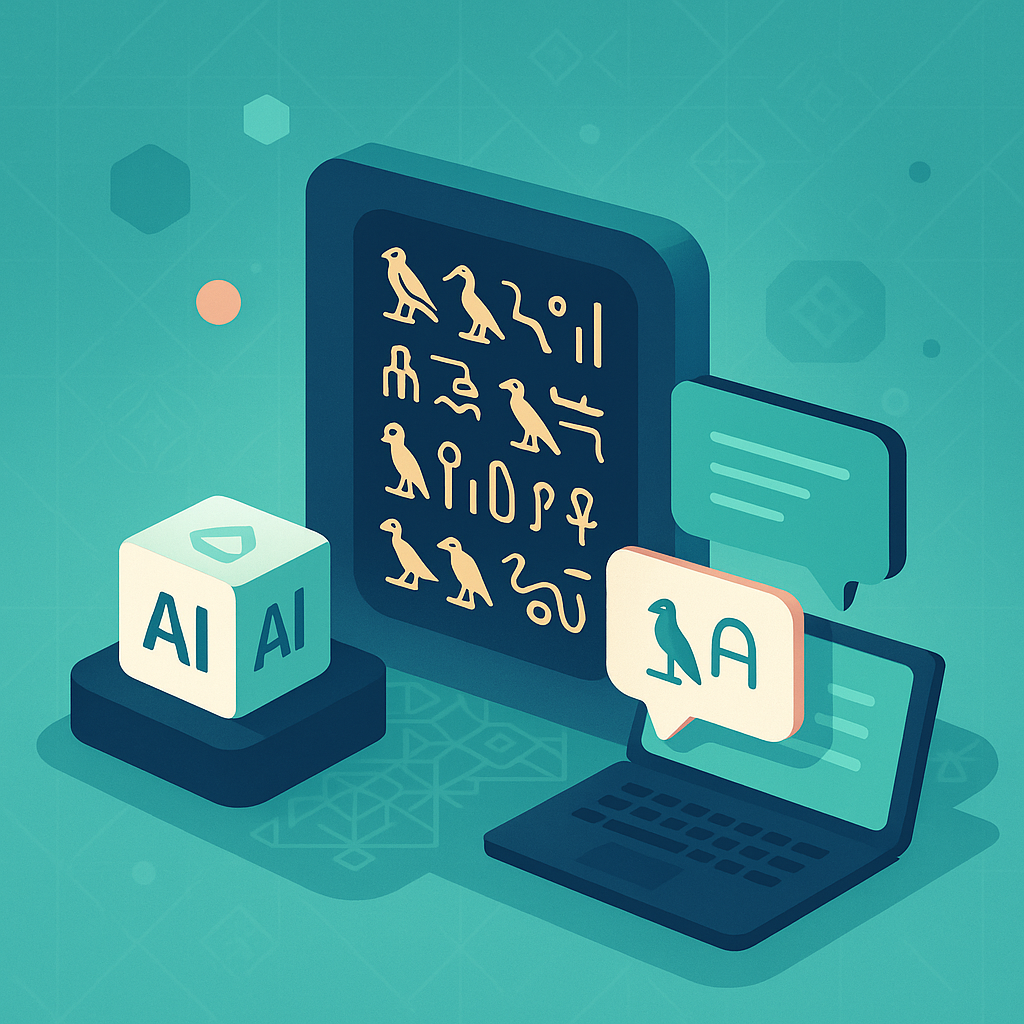
Alexandria-based artificial-intelligence startup TokenAI has released two multimodal models, Horus Hiero (9B parameters) and Horus Hiero Mini (4B parameters), designed to read, translate and reason across Ancient Egyptian hieroglyphics, modern Arabic dialects and more than 100 languages. Both models feature a 128,000-token context window, are being released as open-weight under a custom developer license, and — the company says — were "developed without external funding." TokenAI plans to follow the launch with a Horus Chat web and mobile interface.
"The first in the Arab world to include a native hieroglyphic processing engine," TokenAI said, positioning the release as a milestone for combining epigraphy and modern language AI.
What the new models do
The flagship Horus Hiero 9B and compact Horus Hiero Mini 4B are optimised for cultural heritage, languages and dialects across Egypt and the wider Middle East and North Africa. TokenAI describes the core capability as native hieroglyphic processing: a dedicated engine trained on epigraphic drawings, stone reliefs and papyrus documents that enables direct visual translation of ancient inscriptions into structured English and Arabic without relying on external vision models.
- Context window: 128,000 tokens — large enough to process entire books or multiple papyrus documents in a single inference pass.
- Dialect support: Arabic dialect mapping across colloquial Egyptian, Levantine, Gulf and North African variants.
- Deployment targets: Horus Hiero Mini is designed to run on standard CPUs and mobile devices for offline, real-time translation on budget hardware.
Benchmarks and evaluation
TokenAI also released a Hieroglyphic AI Benchmark to evaluate four dimensions of ancient text processing: recognition (identifying and segmenting symbols per Gardiner’s Sign List), transliteration (phonetic conversion), translation (modern-language renderings) and contextual reasoning (cultural and religious connections between symbols). In TokenAI’s internal evaluation Horus Hiero scored 90.0% overall on the benchmark, with 92.4% on visual symbol recognition and 89.3% on grammatical translation. Horus Hiero Mini scored 84.2% on the same test.
On broader, non-hieroglyphic benchmarks the 9B flagship reportedly scored 79.3% on MMLU-Pro, 78.1% on GPQA Diamond and 83.7% on HumanEval for Python coding. The Mini registered 74.2% on MMLU-Pro and 72.3% on GPQA Diamond.
Context and use cases
The release follows TokenAI’s earlier open-source model, Horus 1.0-4B, an MIT-licensed four-billion-parameter model launched in April; the developer said Horus 1.0-4B outperformed larger models on MMLU despite having fewer parameters. TokenAI founder Assem Sabry has framed the Horus family as specialised tools for cultural heritage and regional language needs.
Practical applications TokenAI highlights include real-time camera-based inscription translation for tourists and museum visitors, multi-dialect enterprise document search, academic Egyptology tools and high-fidelity OCR for historical archives. The company has also produced Horus Lens 1.0, a text-to-image and image-to-image generation model, and says it is developing a more powerful successor to Horus Hiero alongside the upcoming Horus Chat interface.
Outlook
By combining a native hieroglyphic engine, wide language support and a large context window, TokenAI aims to create tools that bridge ancient texts and modern users. With both open-weight releases and mobile-capable deployment, the firm is targeting researchers, cultural institutions and consumer-facing applications. How widely the models are adopted will depend on third-party testing of the Hieroglyphic AI Benchmark, uptake by museums and academic groups, and the performance of the planned Horus Chat interface.
Related Startups
Related Founders
Stay in the loop
Join our weekly newsletter and get the latest MENA startup news, funding rounds, and insights delivered straight to your inbox.