A defining moment in U.S.–Gulf tech relations
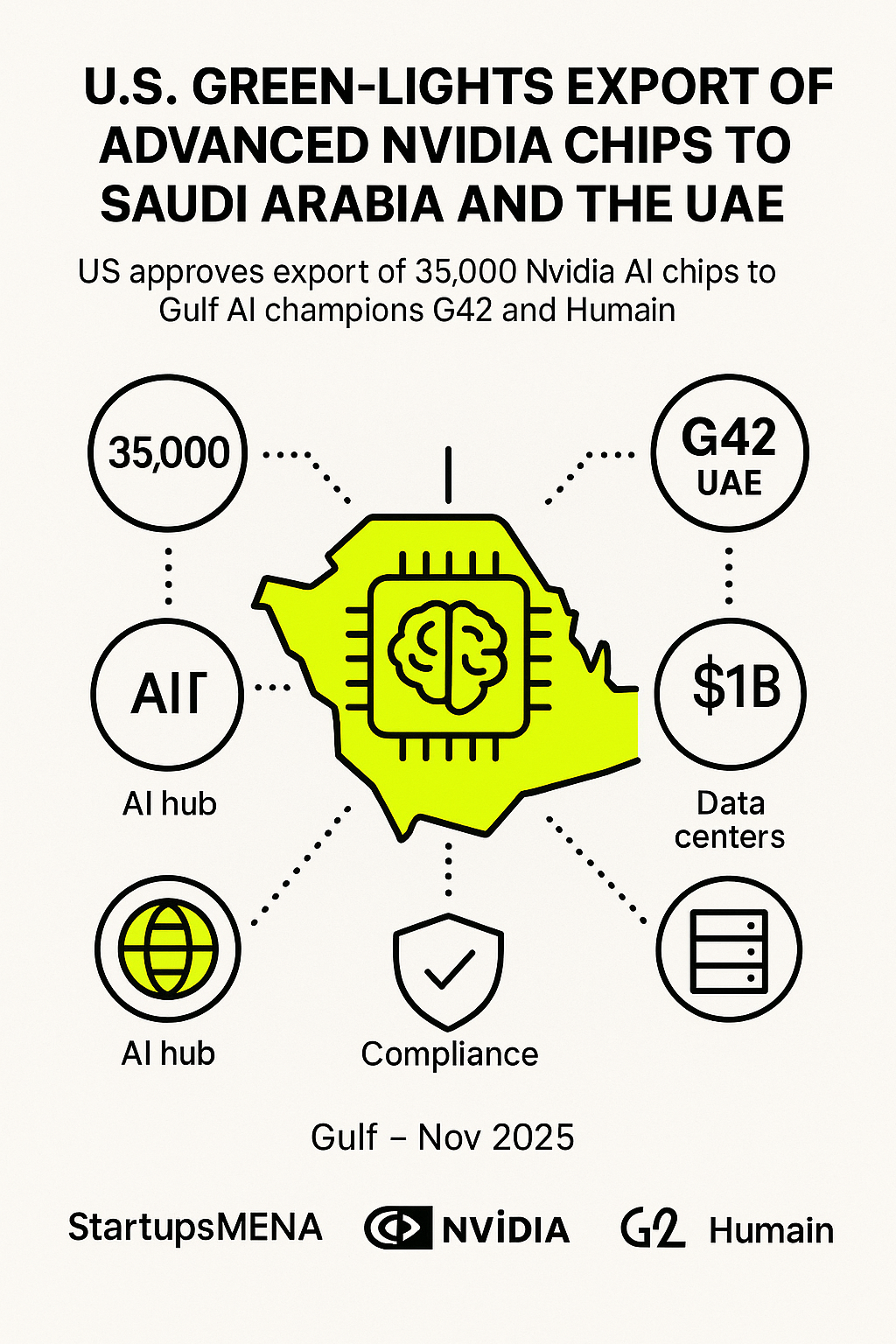
The United States has approved the export of up to 35,000 advanced Nvidia AI chips—valued at roughly $1 billion—to two state-backed companies in the Gulf: G42 in the UAE and Humain in Saudi Arabia.
The move marks one of Washington’s most significant technology transfers to the region, signaling deepening strategic cooperation with two countries racing to become global AI and data-infrastructure hubs.
The decision comes during Saudi Crown Prince Mohammed bin Salman’s first U.S. visit since 2018, highlighting the geopolitical backdrop against which this tech partnership is unfolding.
Why this matters now
The approval is more than an export license—it’s a signal of how global AI power dynamics are shifting.
For the Gulf
Both the UAE and Saudi Arabia are investing billions to build AI supercomputing centers, data infrastructure, and sovereign digital capabilities.
- G42 is developing “Stargate UAE,” a mega data-centre campus backed by major U.S. players including Nvidia, Oracle, Cisco, and OpenAI.
- Humain, Saudi’s new AI venture, has announced ambitions to purchase 600,000 Nvidia chips and develop a 500 MW data-centre in partnership with xAI.
This export approval accelerates both countries’ timelines, giving them access to the world’s most advanced AI hardware.
For the U.S.
The decision reflects a strategic shift: the U.S. is now more willing to authorize the sale of high-end chips to trusted partners—provided strong oversight and security controls are in place.
It also reinforces Washington’s alignment with Gulf nations amid global competition over AI dominance, semiconductor supply chains, and digital infrastructure leadership.
Inside the approval: What the deal includes
The Commerce Department emphasized that the export license is tied to strict security, reporting, and end-use monitoring requirements.
Key elements include:
- Up to 35,000 Nvidia Blackwell-class GPUs authorized.
- Estimated value of ~$1 billion, depending on configuration.
- Export strictly limited to G42 and Humain, both state-backed entities spearheading national AI strategies.
- Requirements for usage transparency and constraints to prevent any potential diversion or unauthorised third-party access.
This represents one of the largest such chip exports ever approved for the Middle East.
How this reshapes the region’s AI trajectory
The UAE and Saudi Arabia have aggressively repositioned themselves as global AI investment magnets. This approval will:
1. Accelerate data-center and supercomputing build-outs
Both countries are already planning multi-gigawatt data-centre campuses with AI-specific capacity. Access to these chips significantly speeds up deployment.
2. Attract global AI model developers
High-end compute is a bottleneck for AI companies worldwide. G42 and Humain could become preferred partners for U.S., European, and Asian firms seeking scalable GPU access.
3. Strengthen sovereign AI capabilities
The Gulf is moving from consumer to producer of AI—building regional infrastructure, models, and potentially foundational AI systems.
4. Enhance the region’s geopolitical relevance
Advanced semiconductor access increases the Gulf’s strategic value in global technology supply chains.
Lessons for the region’s startup and tech ecosystem
While this deal involves state-backed giants, the ripple effects will be felt across the broader innovation landscape:
- Compute access will get cheaper and more available, enabling startups to train or fine-tune advanced models locally.
- AI infrastructure will become a competitive advantage, attracting founders and talent from around the world.
- Compliance and security frameworks will become increasingly central—startups that align with global standards will have more opportunities.
- The region’s shift from “energy hub” to “AI infrastructure hub” will open new sectors: model development, chip-optimized software, LLM safety, data labeling, and applied AI.
The Gulf’s ambition is clear: build not just companies, but entire AI economies.
What to watch next
This approval opens the door to broader U.S.–Gulf tech cooperation. Key developments to monitor:
- Delivery timelines and deployment into UAE and Saudi data-centres.
- How G42 and Humain meet reporting and compliance obligations.
- Potential for additional waves of U.S. semiconductor approvals.
- Competitive responses from China and other global players.
- How this growth in AI infrastructure shapes startup formation and talent inflow in the region.
The next 12 months could redefine the Gulf’s position in the global AI hierarchy.
Editor’s Note — The Startups MENA Team
At Startups MENA, we focus on the narratives that define how the Middle East builds its next-generation workforce and innovation economy. The U.S.’s latest approval for the Gulf to access advanced semiconductors is more than a trade development—it’s a blueprint for how the region can anchor its AI ambitions through global technology partnerships and sovereign infrastructure.
By linking geopolitics, startup ecosystems, and data-centre build-out, this milestone shows how the Middle East is evolving from a consumer of global technology to a creator of future AI capacity.
As the UAE and Saudi Arabia accelerate toward their 2030 visions, the shift is clear: from dependence on opportunity to creation of opportunity—where startups, data hubs, and global tech platforms converge to build a self-sustaining innovation economy.
— The Startups MENA Editorial Team