A Strategic Partnership That Redefines AI Power Dynamics
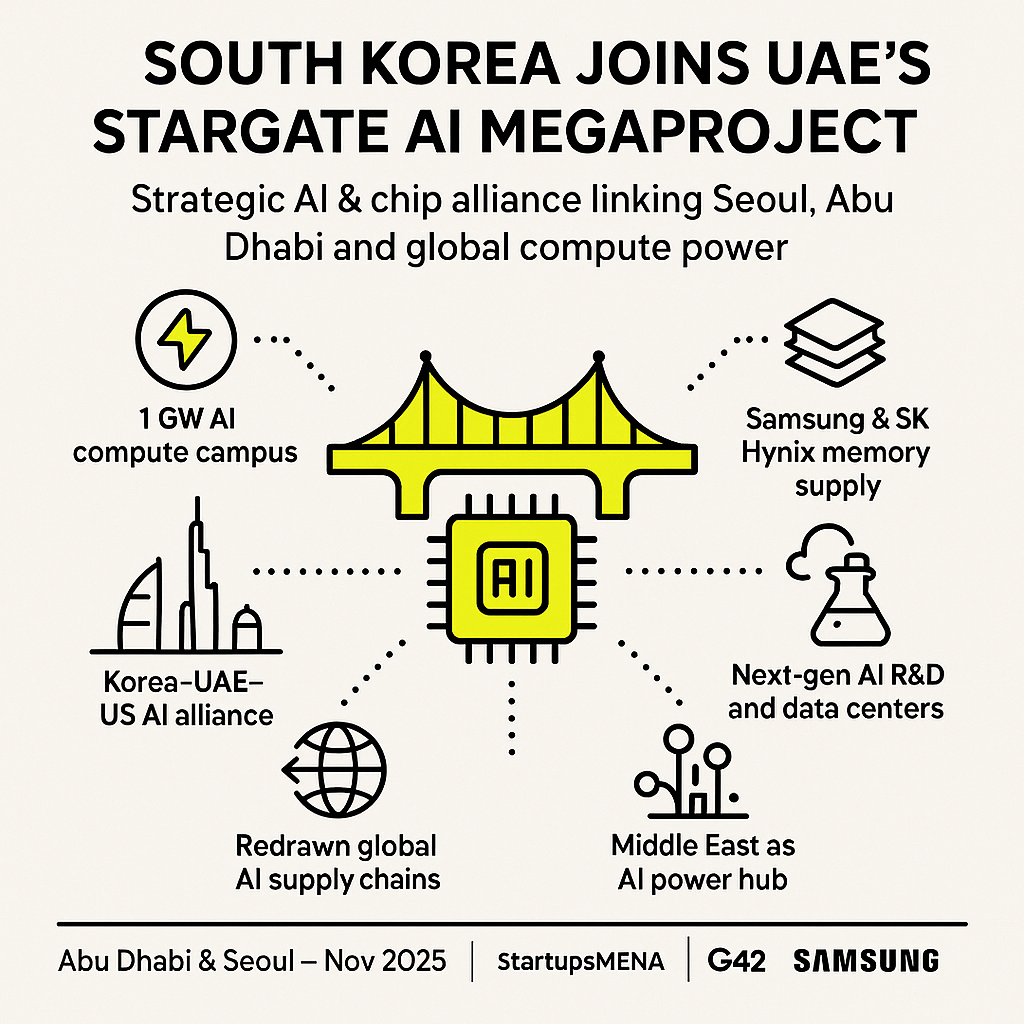
South Korea has formally entered the UAE-led Stargate AI initiative — an ambitious multi-billion-dollar effort to build one of the world’s largest AI data-center networks outside the United States. The agreement, signed during President Lee Jae-myung’s summit visit to Abu Dhabi, marks a major step in South Korea’s push to become a top-tier global AI hub.
The partnership expands the UAE’s role as a rising AI powerhouse and strengthens Seoul’s position in the rapidly evolving global semiconductor and AI supply chain. It also signals accelerating international interest in the Stargate project, which is backed by leading U.S. and global technology players.
Inside the Stargate Project: A New Global Compute Super-Network
The Stargate initiative — led by UAE-based G42 in collaboration with major U.S. and Asian technology partners — aims to develop a 1-gigawatt AI compute campus capable of powering future-scale model training, advanced R&D, and high-density cloud infrastructure.
South Korea’s entry into the project covers several pillars:
- AI infrastructure development and investment
- Advanced semiconductor collaboration, particularly memory and high-bandwidth chips
- Joint R&D across next-generation AI technologies
- Potential future data-center construction in Korea
Two of South Korea’s most influential firms — Samsung Electronics and SK Hynix — have already signaled their participation through preliminary supply agreements for critical memory components. The projected hardware demand for the first phases of Stargate is vast, potentially requiring chip output that exceeds current production levels.
Why Korea Is Joining: Chips, Strategy, and AI Ambition
South Korea’s motivation goes far beyond supplying hardware.
The country is aiming to expand its global AI footprint at a time when:
- Advanced chips have become central to geopolitical influence
- The U.S. is deepening international AI alliances
- Global compute demand is rising faster than global capacity
- Major economies are racing to secure long-term access to AI infrastructure
By teaming with the UAE — one of the world’s fastest-growing AI investment hubs — Korea positions itself at the center of a new AI-infrastructure trilateral: U.S. – UAE – South Korea.
This alignment strengthens Korea’s strategic relevance while opening the door for large-scale exports, co-development opportunities, and regional influence in AI policy and infrastructure standards.
Why the UAE Chose Korea: Capability Meets Reliability
For the UAE, South Korea offers:
- The most advanced memory-chip supply chain in the world
- Proven large-scale manufacturing reliability
- A strong government commitment to AI infrastructure
- Shared alignment with U.S. partners and regulatory frameworks
As the UAE scales Stargate into a long-horizon AI ecosystem, Korea represents a dependable, globally aligned partner capable of supplying both hardware and expertise at unprecedented levels.
A Deal With Global Implications
The partnership carries implications far beyond bilateral cooperation.
1. AI Capacity as National Infrastructure
Stargate reflects the emerging global reality: AI capacity is becoming as vital as energy, transportation, or national security infrastructure.
2. New Tech Alliances Are Emerging
Traditional East–West alliances are evolving into AI-era partnerships that blend infrastructure, chips, compute, and sovereign digital strategies.
3. Supply Chains Are Being Redrawn
As AI models scale, the world is shifting from single-country dependence to distributed, multi-partner supply ecosystems.
4. The Middle East Is Becoming a Global AI Power Center
The UAE’s rapid investment — and willingness to align with top global partners — is creating a new geographic axis for AI innovation.
What Comes Next
The agreement opens the door for several next-stage developments:
- Formal investment disbursements and implementation timelines
- Possible selection of South Korean sites for data-center expansion
- Joint research programs between Korean institutions and G42
- Increased Korean export opportunities in HBM, DRAM, and advanced chip packaging
- Heightened U.S. oversight as AI-infrastructure alliances expand
While the framework agreement is broad, its impact is likely to be long-lasting, influencing not just AI development but global supply-chain strategy for years to come.
Key Takeaways
- South Korea has officially joined the UAE’s flagship AI infrastructure project, Stargate.
- The collaboration strengthens Korea’s role in global AI, chips, and compute infrastructure.
- The UAE gains a highly capable, technologically aligned partner to scale its AI ambitions.
- The project signals a shift toward international alliances in AI infrastructure, with the Middle East playing a rapidly growing role.
- The success of Stargate will depend on execution speed, regulatory clarity, and the ability to scale hardware production at unprecedented levels.
Editor’s Note — The Startups MENA Team
At Startups MENA, we focus on the narratives that define how the Middle East builds its next-generation workforce and innovation economy. The UAE’s new initiative to train 10,000 youth and create 30,000 jobs is more than a development program—it’s a blueprint for how a nation future-proofs its human capital.
By merging education, entrepreneurship, and digital innovation through StartupEmirates.ae, this campaign moves beyond traditional job creation. It lays the groundwork for an ecosystem where young Emiratis are not just employees, but founders, builders, and contributors to a self-sustaining economy.
As the UAE continues to accelerate toward Vision 2030 and Centennial 2071, the focus is shifting from dependence on opportunity to the creation of opportunity. This marks a defining chapter in the region’s transformation—where youth empowerment is not a policy goal, but the foundation of economic resilience.
— The Startups MENA Editorial Team