Saudi Arabia to build 14GW AI computing capacity in partnership with private sector and Silicon Valley
Saudi Arabia is partnering with private sector and Silicon Valley firms to build more than 14GW of AI computing capacity under the HUMAIN initiative, combining compute, capital and customer access to attract and scale global AI companies. The programme involves meetings and partnerships with AI and hardware firms such as Groq, Arcee AI, Engramme, Supermicro, Upscale AI and Velaura AI.
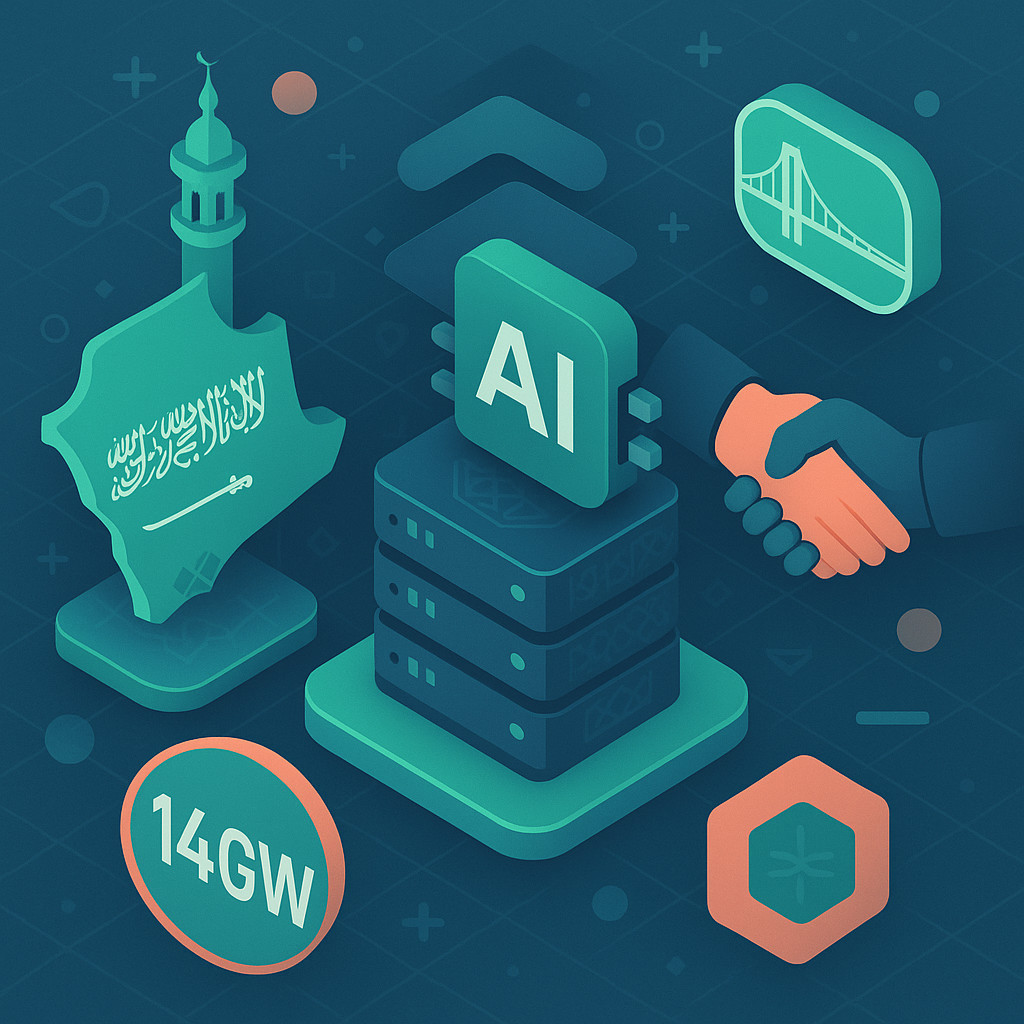
Saudi Arabia is working with the private sector and Silicon Valley partners to develop more than 14 gigawatts of AI computing capacity as part of an integrated model designed to attract and scale global artificial intelligence companies, Communications and Information Technology Minister Abdullah Al Swaha said. The programme will combine three core elements — computing capacity, capital and access to customers — and is intended to lower operating costs, boost infrastructure efficiency and meet the demands of advanced AI firms.
"Our approach centres on three elements: computing capacity, capital and access to customers," Al Swaha said at the opening of the Frontier Leaders Forum in Silicon Valley. He cited Groq as an example, saying Saudi Arabia had been "among the company’s early supporters by giving it access to major customers, investing in the business and creating an environment that allowed it to expand."
Context and strategic partnerships
Al Swaha outlined the kingdom’s strategy while on a visit that included a series of meetings with US investors, hardware and AI companies focused on linking software, models and applications to new infrastructure being developed under the HUMAIN initiative. The 14GW-plus capacity is being created in partnership with private sector firms and aims to provide the scale required by next-generation large models and other compute-intensive AI workloads.
- Investment and deployment talks: Al Swaha met Hemant Taneja, chief executive of General Catalyst, to discuss expanding the firm’s AI investments in Saudi Arabia and enabling portfolio companies to deploy applied AI solutions using HUMAIN’s computing capacity in priority sectors.
- Model and enterprise adoption: Discussions with Mark McQuade, founder and chief executive of Arcee AI, focused on wider use of the company’s open Trinity models and customised enterprise models through HUMAIN’s infrastructure, including systems deployable in private and cloud environments.
- Advanced capabilities: Meetings with Gabriel Kerman, co‑founder and chief executive of Engramme, covered AI memory and continuous‑learning applications intended to let organisations build models that learn from their own knowledge and context.
- Hardware and efficiency: Al Swaha met Charles Liang, founder and chief executive of Supermicro, on accelerating AI factory solutions and expanding liquid cooling, high‑density infrastructure and integrated systems to improve energy efficiency. He also discussed networking with Baron Carr, chief executive of Upscale AI, and energy‑efficient computing with Rajeev Khemani, co‑founder and chief executive of Velaura AI.
Applications and outlook
Al Swaha highlighted the kingdom’s growing use of generative, agentic and physical AI across several domains, naming healthcare, AI agents that support government employees, and autonomous systems in transport and logistics as priority areas for applied deployments. The combination of large-scale compute provided by HUMAIN, targeted investment from partners and guaranteed customer access is meant to create an ecosystem that helps AI firms scale internationally.
Looking ahead, Saudi Arabia intends to deepen its ties with Silicon Valley "through talent, technology and trust," Al Swaha said, while supplying computing capacity, customers and capital to support the next generation of AI companies. The programme’s success will hinge on execution across infrastructure buildout, energy efficiency measures and attracting both model developers and enterprise adopters to run production workloads at scale on the kingdom’s platforms.
Related Startups
Groq
AI hardware company cited as an example of a firm supported by Saudi partnerships and customer access.
General Catalyst
Venture capital firm exploring expanded AI investments in Saudi Arabia and enabling portfolio companies to use HUMAIN computing capacity.
Arcee AI
Developer of open Trinity models and customised enterprise models for deployment via HUMAIN infrastructure.
Engramme
Works on AI memory and continuous-learning applications to build models that learn from organisational knowledge and context.
Supermicro
Provider of high-density servers and integrated systems; discussed accelerating AI factory solutions and expanding liquid cooling and energy-efficient infrastructure.
Upscale AI
Networking-focused company involved in discussions around infrastructure for AI deployments.
Velaura AI
Company focused on energy-efficient computing discussed in the context of HUMAIN infrastructure and efficiency.
Related Founders
Stay in the loop
Join our weekly newsletter and get the latest MENA startup news, funding rounds, and insights delivered straight to your inbox.