Riyadh – A Saudi Arabian AI startup, HUMAIN, which was established in May 2025 under the country’s sovereign wealth vehicle Public Investment Fund (PIF) and chaired by Mohammed bin Salman, has unveiled plans to release a new operating system built from the ground up for voice- and agent-driven computing.
Inside the Technology: What Makes HUMAIN 1 Different
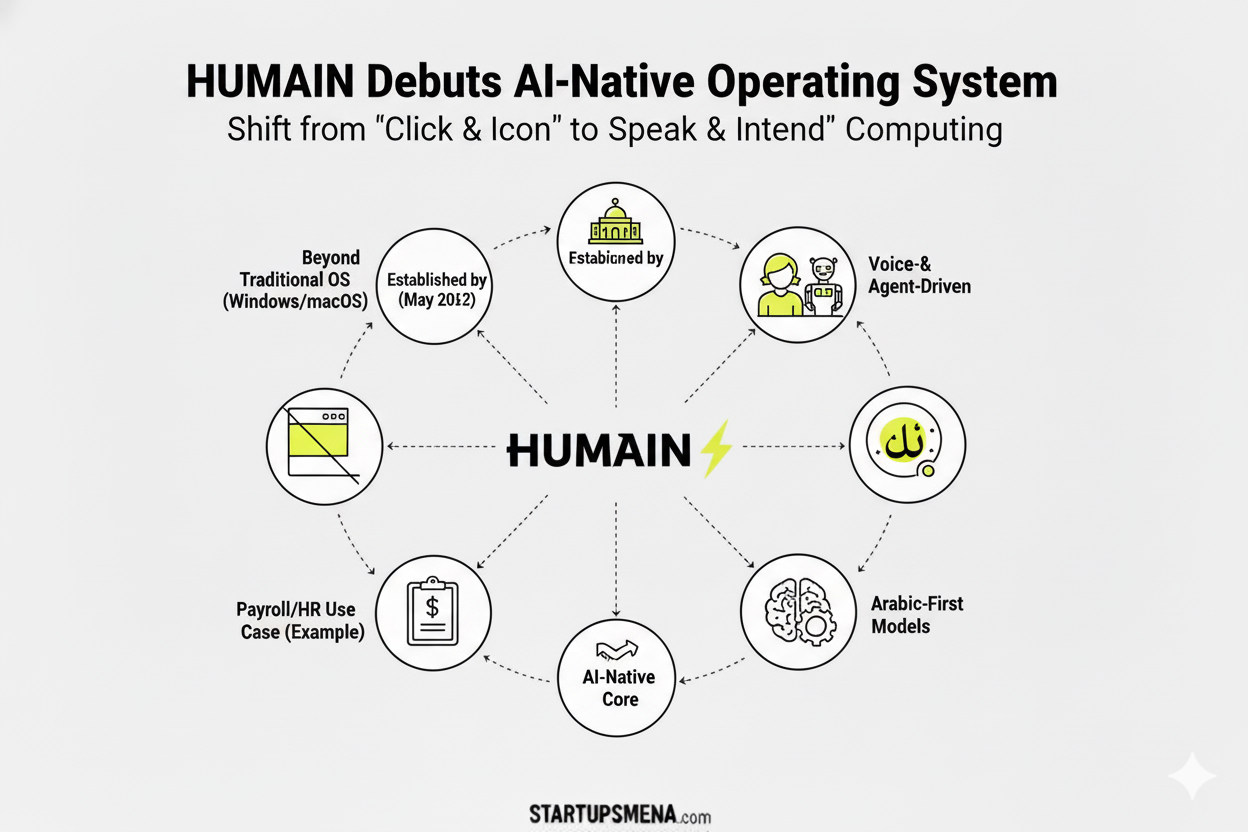
The operating system — referred to as Humain 1 (or Humain One OS) — is intended to go beyond the traditional windows/icons model that has dominated computing with platforms such as Microsoft Windows or macOS, and instead allow the user to speak their intent and have the system respond accordingly.
For example, as HUMAIN CEO Tareq Amin explained, instead of clicking an icon to open “Email” then typing a search, you might say: “Show me this week’s payroll approvals,” and the OS would navigate and act accordingly.
The company reports it has already been using the OS internally — for instance in payroll and HR functions.
HUMAIN’s Strategy: From Cloud to Hardware
HUMAIN is not just launching software. It has a much broader ambition across the AI value chain: building AI infrastructure, data-centres, cloud services, advanced AI models (including Arabic-language large language models) and hardware partnerships. In its announcement, HUMAIN stated plans to build roughly 6 gigawatts of data-centre capacity, though locations, timelines and details remain scant. The company also partners with significant global tech players (e.g., a laptop device called “Horizon Pro” powered by Qualcomm’s Snapdragon X Elite is part of its rollout).
A Pillar of Vision 2030: Saudi’s Push for AI Sovereignty
The launch of HUMAIN and its operating-system ambitions align with Saudi Arabia’s broader “Vision 2030” drive to diversify its economy away from oil and build globally competitive tech sectors. The PIF’s backing and the speed of rollout indicate the country’s serious push into AI sovereignty.
By developing an OS that supports Arabic-first models, local data-sovereignty and new user paradigms (voice/agent rather than icon/menu), HUMAIN could become a home-grown contender in a space dominated by legacy systems.
Risks, Rewards, and What Comes Next
- Market adoption & ecosystem: To compete with entrenched OSs, HUMAIN will need developer ecosystems, application compatibility, hardware support and user trust.
- Performance & usability: Voice/agent interfaces are not yet the norm for most computer workflows. The user experience will need to be compelling to win over average users.
- Localization and global scaling: While Arabic-first is a strong differentiator in the Middle East, scaling globally will require multi-language support, broad hardware partners and strong alliances.
- Timing and rollout transparency: Although the system is slated for “this week” launch (per the announcement) many details remain unspecified (hardware partners, pricing, availability, enterprise vs consumer focus).
- Competitive responses: Major players such as Microsoft and Apple are also pursuing AI-first / voice/agent capabilities, so HUMAIN will face established competition.
Final Thoughts: A Bold Leap for Saudi Tech
HUMAIN’s announcement of an AI-native operating system is bold and noteworthy. The emphasis on voice/agent interactions, Arabic-first models and end-to-end infrastructure signals Saudi Arabia’s intent to carve out a global AI role. Whether HUMAIN can turn this promise into mainstream adoption remains to be seen — but the direction is clear: computing may be shifting from “click & icon” to “speak & intend.”
For those tracking the Middle East’s tech ecosystem, this is one to watch.
Editor’s Note — From the Startups MENA Team
At Startups MENA, we continue to spotlight the innovators redefining what’s possible across the region’s fast-evolving tech landscape. HUMAIN’s debut of an AI-native operating system represents more than a product launch — it marks a defining step in Saudi Arabia’s ambition to become an architect, not just a participant, in the global AI economy.
As the Kingdom accelerates its Vision 2030 agenda, HUMAIN’s approach — building end-to-end AI infrastructure, from large-scale data centers to locally trained language models — signals a decisive shift from software adoption to deep technological creation. It’s a reminder that the region’s competitive edge will come from owning its digital future, layer by layer.
For MENA’s startup ecosystem, this moment is symbolic: innovation is no longer imported — it’s being designed, trained, and deployed from within. The founders and technologists who understand the nuances of local markets while thinking at global scale will define the next chapter of AI.
— The Startups MENA Editorial Team