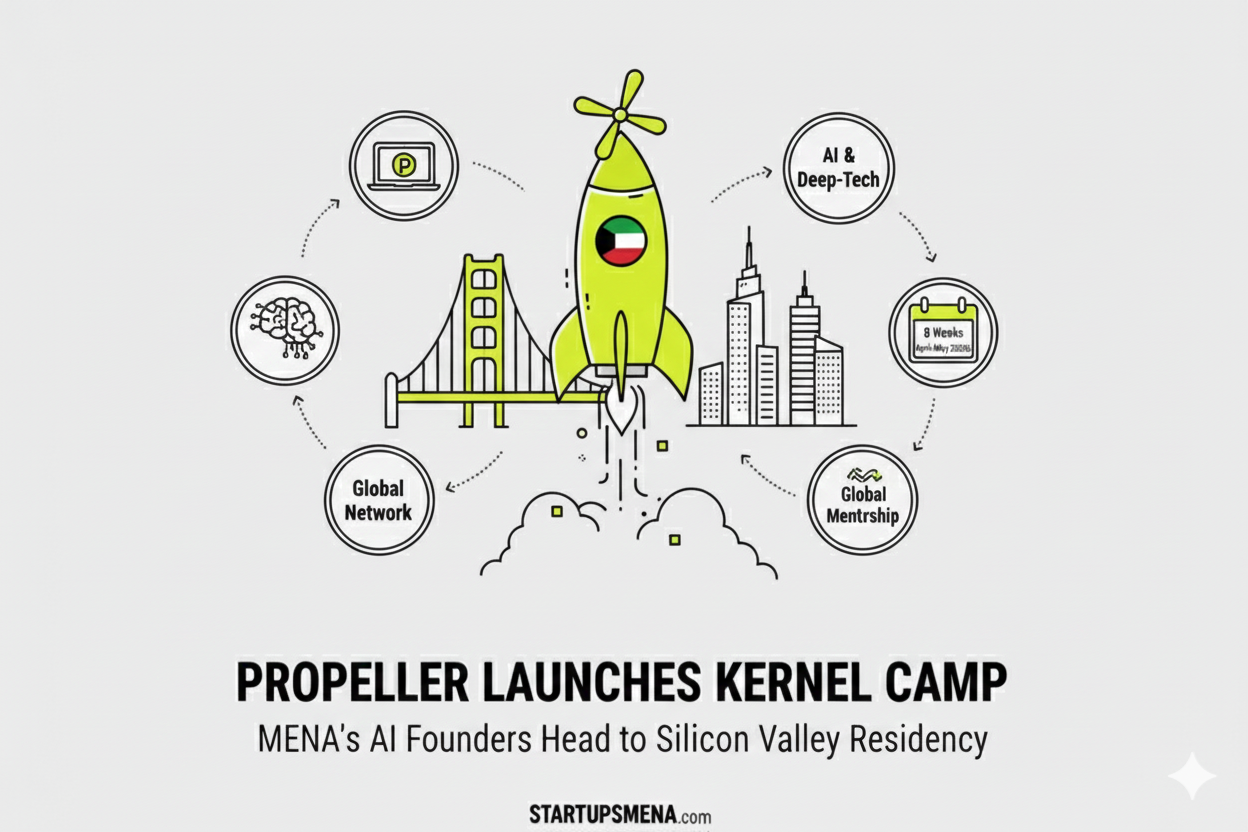
Propeller, a venture capital firm focused on AI infrastructure, has announced the launch of Kernel Camp, an eight-week sponsored deep-tech and AI residency designed for early-stage founders from the Middle East and North Africa. The first cohort is scheduled to take place in San Francisco between April and May 2026, placing selected startups at the heart of Silicon Valley’s technology ecosystem.
Kernel Camp aims to support technically driven founders who are building demo-ready products and are looking to refine their technology, strengthen product-market fit, and expand their global networks. The programme offers a structured residency that combines hands-on mentorship, expert-led sessions, and direct exposure to operators and investors working at the forefront of AI and infrastructure.
A Silicon Valley Immersion for Technical Builders
Founders selected for Kernel Camp will receive fully sponsored accommodation in San Francisco for the duration of the programme, along with access to a curated calendar of workshops, technical deep dives, and closed-door discussions. The residency will also include one-on-one mentorship with experienced founders, engineers, and investors, as well as site visits to leading technology companies.
The programme will culminate in a demo day, giving participating startups the opportunity to showcase their progress to Propeller’s network of investors and ecosystem partners. By embedding founders in Silicon Valley for an extended period, Kernel Camp is designed to go beyond short exposure visits, offering founders the time and space to meaningfully engage with one of the world’s most mature deep-tech ecosystems.
Propeller Founder and Managing Partner Zaid Farekh said the initiative reflects the firm’s belief that the MENA region is producing strong technical talent, particularly in AI and infrastructure, but that many founders lack sustained access to global product and distribution networks at an early stage.
Partner Hani Azzam added that proximity to experienced builders and a strong peer community can significantly shape how early deep-tech companies evolve, particularly when it comes to technical decision-making and long-term scalability.
Extending Propeller’s Cross-Border Strategy
The launch of Kernel Camp builds on Propeller’s broader cross-border investment strategy. In late 2025, the firm announced the close of Fund III, a $50 million fund focused on AI infrastructure and deep software companies operating across MENA and the United States.
Propeller currently operates across Amman, Riyadh, Boston, and Silicon Valley, positioning itself as a bridge between regional talent and global markets. Fund III has already backed several companies with U.S. market exposure, including Codemod, Netpreme, Stealthium, Pebble, and Ciphero AI, reflecting the firm’s focus on startups building foundational technologies rather than consumer-facing applications.
Kernel Camp represents a non-capital extension of this approach, offering founders hands-on access to the environments where many global AI and infrastructure companies are built and scaled.
What It Signals for MENA’s Deep-Tech Ecosystem
As MENA’s startup ecosystem continues to mature, initiatives like Kernel Camp highlight a growing emphasis on global-first execution, particularly in deep-tech sectors where technical depth, long sales cycles, and ecosystem access play a critical role.
For early-stage founders, extended residencies can provide valuable exposure to international standards around product development, fundraising, and go-to-market strategy. However, the long-term impact of such programmes often depends on how effectively founders translate short-term immersion into sustained growth once they return to their home markets.
Applications for the first Kernel Camp cohort are expected to open ahead of the April 2026 start date.
Editor’s Note
As venture capital firms in the region increasingly experiment with founder support models beyond funding, programmes like Kernel Camp signal a shift toward deeper, more hands-on ecosystem building. While extended residencies can offer meaningful exposure and access, they are not a substitute for strong fundamentals, execution discipline, or long-term market understanding. The success of such initiatives will ultimately be measured not by demo days or visibility, but by whether participating founders are able to translate global exposure into durable companies rooted in clear value creation.