Nvidia’s free AI model could push the UAE closer to the U.S.
By licensing Poolside and pushing its free Nemotron open-weights model, Nvidia may lock in hardware dominance across the UAE, challenging local models and Chinese open-source AI.
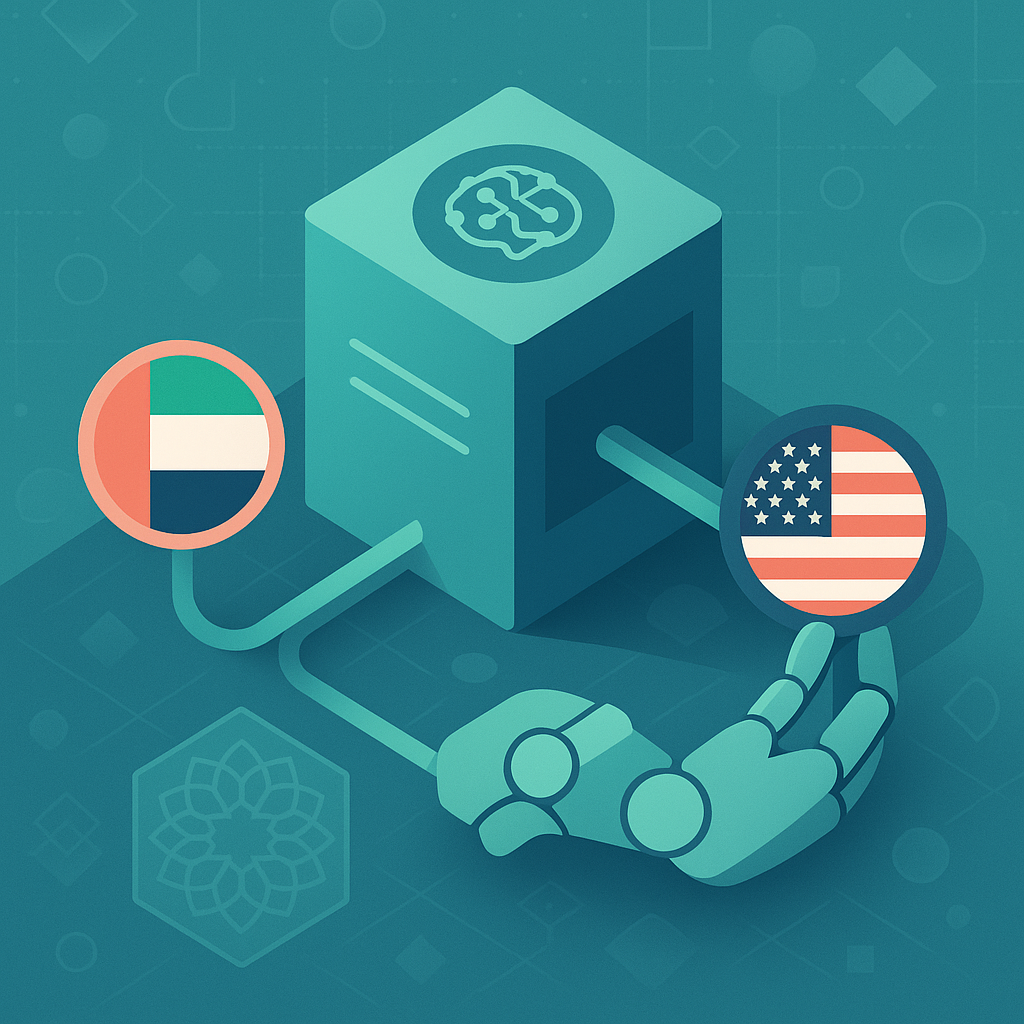
Nvidia’s recent moves in AI software threaten to deepen the United Arab Emirates’ technological alignment with the United States. Last month Nvidia spent $7 billion to buy a stake in U.S. coding startup Poolside and licensed the tools Poolside uses to build AI models. Nvidia plans to release a free, open-weights model—expected to be called Nemotron 4—by the end of the year, a model analysts say is aimed at users already running Nvidia hardware; the UAE’s flagship data centre, for example, will run on 400,000 Nvidia chips.
“The last missing piece was the model layer,” Mohammed Soliman, a senior fellow at the Middle East Institute, said. “Nvidia already owns the chips. Now it is scaling the factory that produces the models that run on those chips, and it is releasing them as open weights.”
The Poolside deal and the planned Nemotron model represent a strategic shift. Nvidia is not only locking in hardware sales but also pushing a software stack that could become the default base for governments and companies that already use its accelerators. Marc Einstein, an analyst at Counterpoint Research, framed the move as targeting organisations that have invested heavily in Nvidia hardware: the new model “is aimed at buyers already running Nvidia hardware,” he said. Nvidia has also agreed to pay almost $13 billion to buy Hugging Face, a platform where developers download and share models; the acquisition is intended to boost Nemotron’s adoption and counter popular free models from China that have been downloaded at scale.
That dynamic has particular resonance in the UAE, where two major institutions have taken diverging approaches to sovereign AI. The Technology Innovation Institute (TII), the government lab behind the Emirati model Falcon, insists on building models from the ground up to retain technological sovereignty. “As a model-building lab, we believe that maintaining diversity in AI perspectives, and preserving full technological sovereignty, requires a strong, homegrown foundation,” Hakim Hacid, TII’s chief researcher, said. “The value is not limited to the models we ultimately produce, but it lies in mastering the underlying technology and retaining control across the entire AI stack.”
- G42, the state-backed company that runs much of the UAE’s AI infrastructure, has aligned itself publicly with Nvidia’s open-model push. Its CEO, Peng Xiao, wrote on X that “Frontier open models are an essential part of that future, alongside frontier closed models, with security, trust and sovereign control designed in from the start rather than bolted on later.”
- Falcon, built by TII in 2023 as a free alternative, ranked first this year on Counterpoint’s index of state-backed models.
- Other regional players hedge: Saudi Arabia’s Humain has bought Nvidia chips and commissioned Chinese labs to develop Arabic-language models, illustrating mixed sourcing across hardware and software.
Experts say the choice is not binary. “Sovereignty was never about inventing the foundational model from scratch,” Soliman added. “It is about the model’s weights, how you fine-tune the data, and, most importantly at this stage, your ability to serve these models to users in the UAE and other markets.” Sam Winter-Levy, a senior fellow at Carnegie Endowment for International Peace, noted that states will continue to hedge: “The Saudis are using Chinese AI models to build their own models, while using U.S. chips to develop and run them.”
Outlook: If Nemotron achieves broad adoption, Nvidia could consolidate a full-stack position in markets already dense with its accelerators, nudging countries like the UAE closer to U.S. software ecosystems even as they preserve certain local layers such as fine-tuning, serving, and data governance. The next year will test whether domestic efforts like Falcon can coexist with, or be subsumed by, a freely distributed Nemotron ecosystem running on hundreds of thousands of Nvidia chips.
Stay in the loop
Join our weekly newsletter and get the latest MENA startup news, funding rounds, and insights delivered straight to your inbox.