Inside the UAE's $30 bn AI bet: where Stargate, Innovation City and the GCC's compute map intersect
The UAE is building large-scale AI infrastructure — led by the Stargate hyperscale campus developed by Khazna Data Centres (G42) with global partners — and creating purpose-built ecosystems like Innovation City Ras Al Khaimah to attract AI founders and companies.
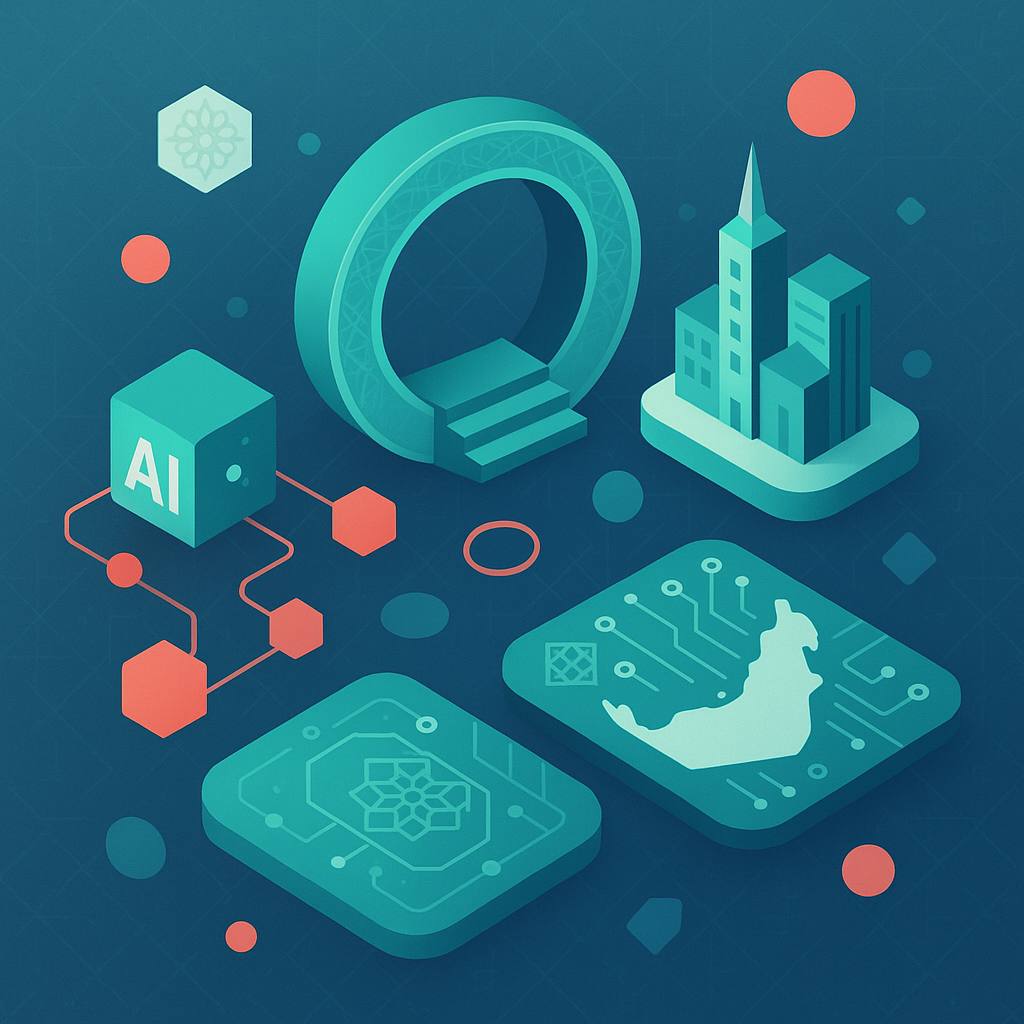
The United Arab Emirates is accelerating an infrastructure-led strategy to anchor a regional AI economy, with Stargate UAE — a 19.2 square kilometre hyperscale campus — under construction in Abu Dhabi and a slate of major cloud and compute commitments arriving alongside purpose-built ecosystems such as Innovation City Ras Al Khaimah. Stargate, developed by Khazna Data Centres (a unit of G42) in partnership with OpenAI, Oracle, NVIDIA, Cisco and SoftBank, is designed to consume up to five gigawatts of power; its first phase is expected to be completed in the third quarter of 2026. Microsoft has committed more than $7.9 billion to AI and cloud infrastructure in the UAE between 2026 and 2029, part of a $15.2 billion total investment since 2023 announced at a meeting between Sheikh Khaled bin Mohamed and Microsoft President Brad Smith.
Direct quote
UAE Minister for Artificial Intelligence Omar Al Olama framed Stargate as an audacious national project, calling it proof of the country's ability to build things "that no one has the audacity to dream of".
Context and details
Stargate has been described as the most ambitious AI infrastructure project attempted outside the United States. Its scale and the roster of global technology partners position the campus as a regional compute anchor that could support advanced generative AI training and inference workloads. The presence of OpenAI alongside hardware and systems partners including NVIDIA and Cisco signals ambitions beyond traditional data centre capacity — aiming to provide low-latency, sovereign compute for enterprises, governments and startups across the Gulf Cooperation Council.
Alongside Stargate, the UAE's cloud landscape is deepening. Microsoft, AWS and Google Cloud have established infrastructure in the country, and Microsoft’s multi-billion-dollar expansion was made public during an official meeting between Sheikh Khaled bin Mohamed, Crown Prince of Abu Dhabi, and Brad Smith, reflecting high-level political backing for the private-sector investments. Microsoft’s announced $7.9 billion spend from 2026 to 2029 adds to a broader corporate wave placing substantial capital into regional data centres, networking and cloud services.
Innovation City in Ras Al Khaimah is being marketed as the operational counterpart to that raw compute capacity: a purpose-built AI-powered free zone designed to host founders in AI, Web3, robotics, gaming and healthtech. Under CEO Paul Dawalibi, Innovation City emphasizes speed of incorporation, tailored regulation and community depth aimed at accelerating the formation of product-level companies that can exploit the newly available infrastructure.
Outlook
- Infrastructure timeline: With Stargate’s first phase due in Q3 2026 and major cloud vendors already present, the UAE is shifting the typical sequence — placing infrastructure ahead of application-layer saturation.
- Opportunity window: Officials and ecosystem builders position the current period as a bounded opportunity for founders to establish themselves before application categories become crowded.
- Regional dynamic: Saudi Arabia, Qatar and the UAE are simultaneously pursuing sovereign AI capacity, creating a Gulf-wide compute topology that could reshape where and how AI products are developed and deployed.
For entrepreneurs and investors watching compute, regulation and market demand converge, the UAE’s coordinated industrial and ecosystem moves present a rare moment where physical infrastructure, capital and policy timelines align — making the decision less about whether to relocate and more about whether to act fast enough to claim space in the next wave of AI-native companies.
Related Startups
Khazna Data Centres
Developer of the Stargate hyperscale campus (unit of G42) intended to provide regional sovereign compute for AI workloads.
G42
Abu Dhabi-based AI and cloud technology group; parent of Khazna Data Centres and a key regional AI player.
Innovation City (Ras Al Khaimah)
A purpose-built AI-focused free zone in Ras Al Khaimah aimed at hosting founders in AI, Web3, robotics, gaming and healthtech.
Related Founders
Paul Dawalibi
CEO
Florian Douetteau
Co-founder & CEO
Mohammed Alkhotani
SVP & GM, Middle East
Gabriele Obino
Vice President, Southern Europe & Middle East
Peng Xiao
CEO
Brad Smith
President
Sheik Tahnoon bin Zayed Al Nahyan
National Security Adviser
Jonny Gannon
Former CIA operative
Angela Nganga
Country Lead, East Africa
Phyllis Migwi
Country General Manager, Microsoft Kenya
William Ruto
President
Stay in the loop
Join our weekly newsletter and get the latest MENA startup news, funding rounds, and insights delivered straight to your inbox.