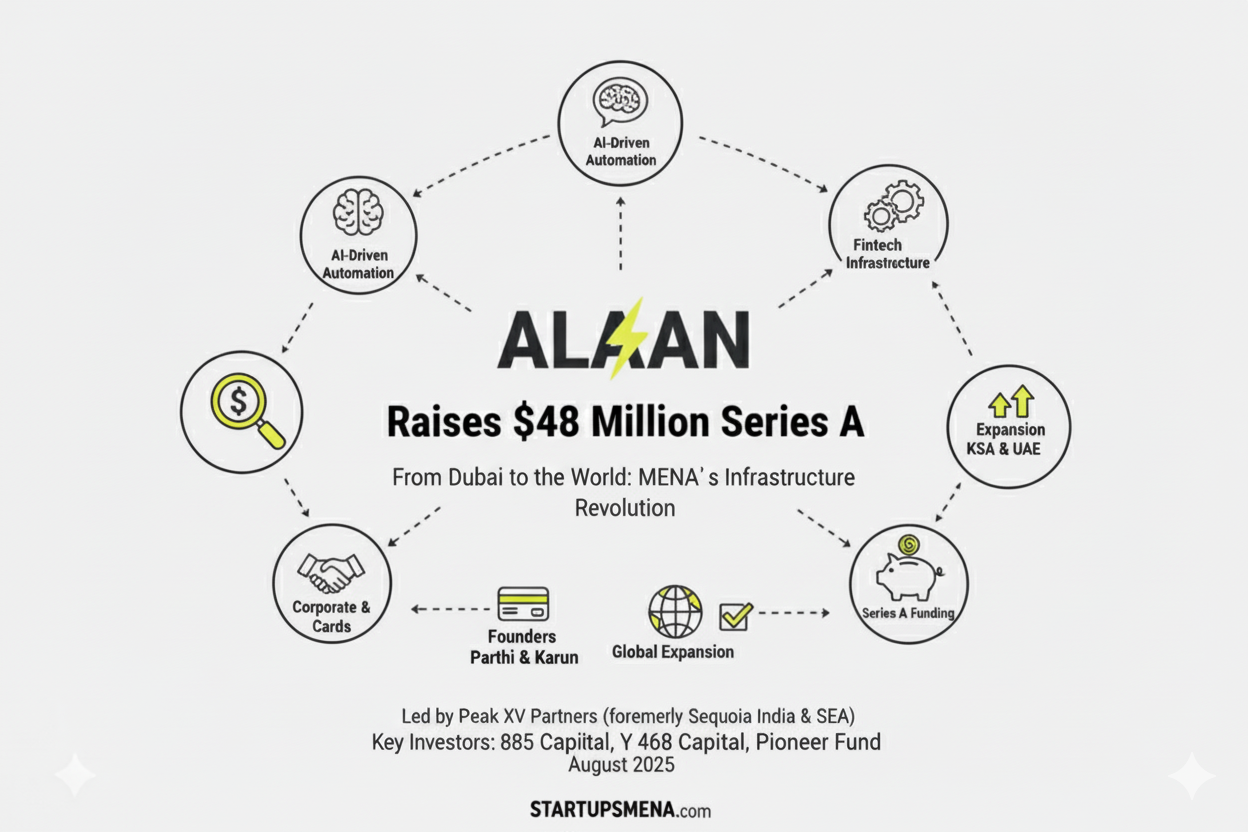
In August 2025, Alaan announced a Series A funding round of US$48 million, led by Peak XV Partners (formerly Sequoia India & SEA).
Key points:
- The round was a mix of primary and secondary capital, indicating both growth funding and liquidity for early investors.
- Participation included founders of 885 Capital (Sudeep Ramnani, Jai Mahtani), Y Combinator, 468 Capital and Pioneer Fund.
- The deal is described as one of the largest Series A funding rounds for a fintech in the Middle East region.
This injection positions Alaan strongly to accelerate expansion and deepen its product footprint.
Founders & Backstory: Solving an Overlooked Pain Point
Alaan was founded in 2022 by Indian-origin consultants Parthi Duraisamy and Karun Kurien, both of whom previously worked at McKinsey & Company.
Their insight: Expense management and vendor payments processes in the MENA region were inefficient—Western-centric corporate cards didn’t always work, reconciliation was manual and local VAT/CT compliance added complexity.
By building a spend-management platform tailored for the region (with corporate cards, real-time tracking, AI-based receipt matching, VAT extraction), they addressed a high-pain area for finance teams.
Product & Traction: From Launch to Momentum
Key product features
- Corporate cards with smart controls and spend visibility.
- AI-driven automation: receipt matching, manual reconciliation reduction, VAT extraction and claims processing.
- Integrations with major finance systems (e.g., QuickBooks, Xero) for regional companies.
Traction highlights
- Processed over 2.5 million transactions since launch.
- Serves over 1,500 finance teams across notable companies, including G42, Careem, Tabby, Lulu Group and Rivoli Group.
- Claim: Saved finance teams 1.5 million+ hours of manual work through automation.
- Expansion into the Kingdom of Saudi Arabia earlier in 2025, with transaction volumes doubling month-on-month for six months.
These metrics demonstrate not just promise, but momentum—a significant differentiator in a crowded fintech ecosystem.
Regional Implications: MENA Fintech, Infrastructure & Strategy
Alaan’s raise and growth reflect broader shifts in the Middle East’s fintech and enterprise infrastructure landscape:
- Investor signal: The fact that Peak XV (an India/SEA-centred fund) led this round signals increased VC interest in Gulf-region fintech infrastructure.
- B2B focus: The shift from consumer fintech to enterprise SaaS/finance ops highlights maturation of the market; companies are willing to invest upstream in spend platforms.
- Regulatory & regional nuance: MENA presents unique challenges—local banking partnerships, VAT/tax regimes, corporate expense policies differ significantly from Western markets. Platforms built for density and depth (rather than just front-end UI) have advantage.
- Expansion playbook: With KSA and UAE as core markets, targeting regional scale is vital. The GCC’s operational scale and regional head-office network are enabling platforms like Alaan to scale across borders.
- Talent & tech: Embedding AI and automation into finance operations in MENA is less common. Alaan’s emphasis on “invisible utility” (e.g., background AI tasks rather than flashy consumer features) is noteworthy.
For stakeholders, this means the next phase of fintech in MENA won’t just be about apps—it’s about rebuilding B2B infrastructure and internal operations of large enterprises and growth companies.
What’s Next: Growth, Challenges & Strategic Levers
Growth roadmap
- With the new capital, Alaan plans to deepen its presence in Saudi Arabia and strengthen roots in the UAE.
- Hiring ramp-up across sales, customer success, and compliance. Regulatory compliance is crucial in these markets.
- Product expansion: Move beyond spend tracking into full “finance ops” platform—covering broader workflows in the finance department (vendors, vendor payments, real-time analytics).
Key challenges to watch
- Competition: As the fintech infrastructure play expands, new entrants or global players may target MENA spend management.
- Localization: Scaling across MENA means different compliance regimes, languages, banking systems—product must adapt.
- Retention & growth unit economics: With rapid volume growth, keeping customer acquisition costs under control while scaling operations will be critical.
- Global currency/regulatory risk: Operating across multiple jurisdictions means exposure to regulatory shifts or macro-headwinds (e.g., interest rates, regional instability).
Strategic levers
- Focus on large enterprises with complex spend flows (real-estate, logistics, retail)—where manual pain is highest. Alaan already has presence in such verticals.
- Leverage AI insights from regional data to build value-added features (e.g., predictive spend, compliance alerts) which raise switching cost.
- Marketplace or ecosystem play: build adjacent services (vendor payment rails, invoice financing, analytics) which feed into the spend platform to increase stickiness.
- Expand beyond UAE/KSA into other GCC and MENA markets—once product-market fit is strong in core markets, regional expansion accelerates valuation and scale.
Editor’s Note — From the Startups MENA Team
At Startups MENA, we focus on the transformative narratives shaping the region’s tech and financial journeys. The $48 million Series A raised by Alaan is far more than a headline—it signals a pivotal shift in how finance teams across the Gulf are being re-engineered for the digital age.
By combining corporate cards, AI-driven reconciliation and automation, Alaan represents the kind of infrastructure-layer fintech that underpins scalable growth in emerging markets. Its acceleration in Saudi Arabia and the UAE proves that regional fintech is no longer just about “front-end” user apps—it’s about bringing enterprise-grade finance operations to life.
As venture capital flows deepen into the Middle East and North Africa, Alaan’s journey reinforces a broader theme: the next wave of fintech innovation here will not just serve consumers—it will rebuild how businesses move money, measure spend and manage back-office work at scale.
— The Startups MENA Editorial Team