A New Milestone for Egypt’s Fintech Momentum
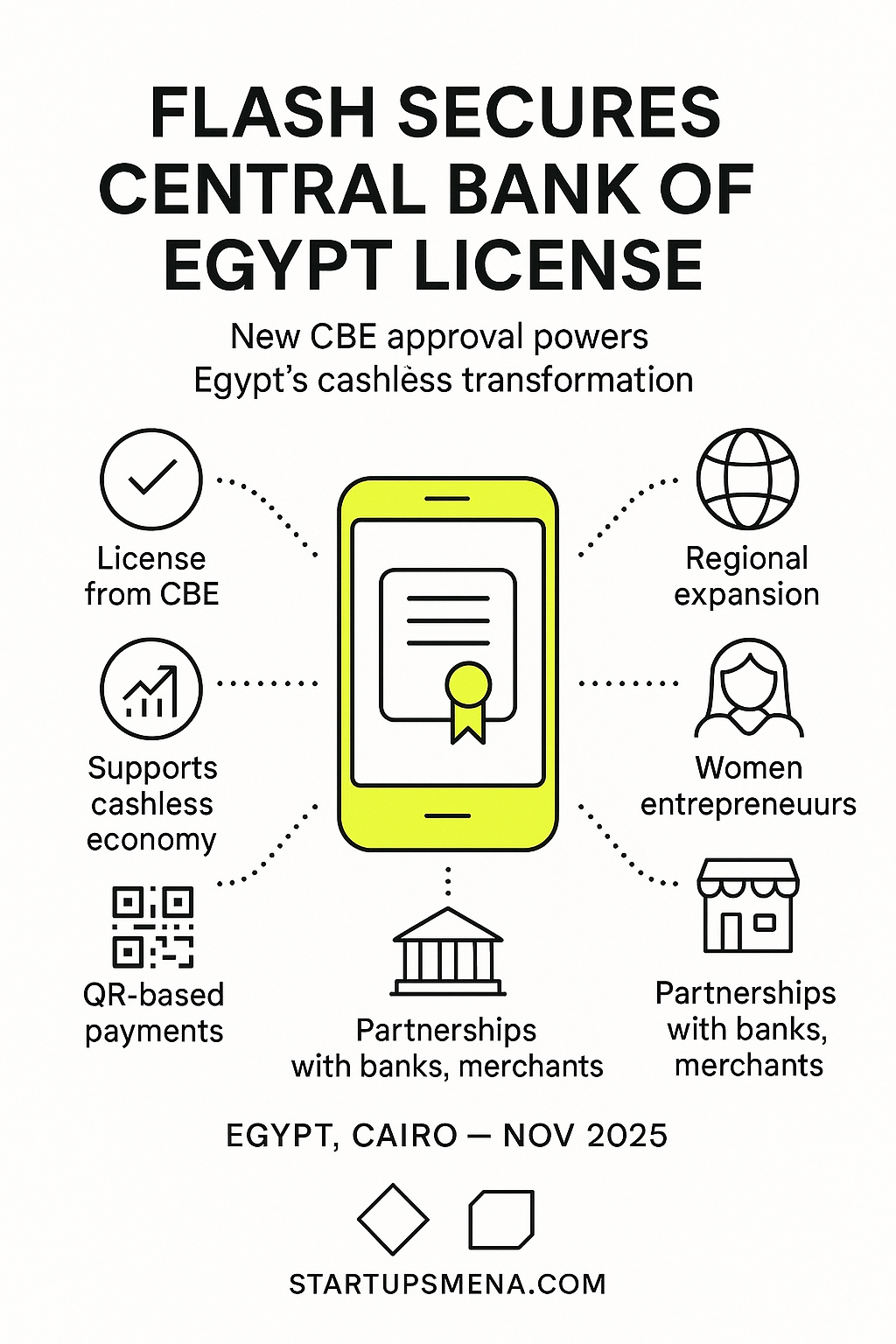
The Central Bank of Egypt (CBE) has officially granted FLASH, the Egyptian digital payments startup, a license to operate as an electronic-payment facilitator and coordinator. The approval signals a pivotal moment for both the company and Egypt’s widening push toward a secure, regulated, and modern cashless economy.
The license—confirmed during the Cairo ICT “PAFIX” event—brings FLASH into the growing circle of CBE-approved fintech operators, reinforcing the nation’s strategy to expand safe digital payments, increase financial inclusion, and raise standards across the ecosystem.
Why FLASH’s License Matters Now
In recent months, the CBE has introduced updated licensing rules for payment-service providers, reflecting Egypt’s accelerating shift toward formalizing digital financial infrastructure. Against this backdrop, FLASH’s recognition is not simply a corporate achievement—it’s evidence of a regulatory environment actively encouraging innovation while ensuring consumer protection.
With digital payments adoption still evolving in Egypt, adding new, compliant players strengthens trust, competition, and market accessibility.
What FLASH Brings to Egypt’s Digital Economy
Co-founder Sherine Kabesh outlined FLASH’s expanding capabilities and growing merchant partnerships, showcasing how the app is designed to simplify payments for both consumers and businesses. Among its most notable value propositions:
- Seamless payments for restaurants and retail, built around simple QR-code interactions.
- Logistics integrations with companies such as Bosta and Milez, enabling card-based and digital transactions across delivery workflows.
- Retail and F&B partnerships with major platforms including Foodics, ACT Integrations, and Robooost, supporting high-volume merchant operations.
- Targeted solutions for women and female entrepreneurs, addressing a historically underserved market segment.
- Collaboration with major banking institutions, including Banque Misr and National Bank of Egypt, enhancing interoperability and trust.
- Regional expansion plans, with ambitions to scale beyond Egypt into broader Middle Eastern and African markets.
This combination of infrastructure and partnerships positions FLASH as a significant contender in Egypt’s rapidly evolving fintech arena.
The Bigger Picture: What This Means for Egypt
1. Strengthening Financial Inclusion
Only a fraction of Egyptians regularly use digital payment tools. Licensing fintechs like FLASH expands accessibility, boosting participation in the formal economy.
2. Raising Market Standards
CBE-registered facilitators must meet high compliance, security, and infrastructure benchmarks. FLASH’s approval helps elevate expectations for reliability and safety across the ecosystem.
3. Enabling a More Competitive Fintech Landscape
As more startups and operators receive clear regulatory pathways, the market becomes more dynamic—encouraging innovation, investment, and higher-quality services.
4. Supporting Egypt’s Digital Transformation Vision
This move is aligned with Egypt’s broader economic roadmap: digitizing financial services, modernizing payment infrastructure, and reducing dependence on cash.
Challenges Ahead for FLASH
Despite its momentum, FLASH must navigate:
- Intense competition among digital-payment providers and aggregators.
- Technical scaling demands, especially as transaction volumes grow.
- Continued regulatory compliance, as the CBE strengthens oversight.
- Consumer-behavior shifts, which historically require time and education to achieve mass adoption.
Execution, differentiation, and operational reliability will determine how effectively FLASH converts its licensing milestone into sustained market leadership.
Takeaways for Founders & Operators Across MENA
FLASH’s journey offers three key lessons for startups in regulated industries:
- Regulatory alignment creates a competitive edge
Compliance isn’t just a requirement—it’s a strategic advantage that builds trust. - Ecosystem partnerships accelerate scale
Collaborating with banks, logistics firms, and platform providers expands distribution and credibility. - Solve specific problems, not general ones
Tailored offerings—for merchants, logistics, or women entrepreneurs—win adoption faster than broad, generic products.
Editor’s Note — The Startups MENA Team
At Startups MENA, we highlight the companies shaping the economic and technological future of the Middle East. The Central Bank of Egypt’s licensing of FLASH reflects more than regulatory progress—it captures a moment where the region’s fintech ecosystem matures into global-standard infrastructure.
By empowering merchants, consumers, and small businesses to transact digitally, Egypt is building the foundations of a more inclusive and innovation-driven economy. Milestones like these mark a shift from simply adopting digital tools to architecting a resilient financial future across MENA.
— The Startups MENA Editorial Team