For small and medium businesses across the GCC that can wait months for a bank loan, a Dubai-based fintech is betting that funding should arrive in days instead of quarters.
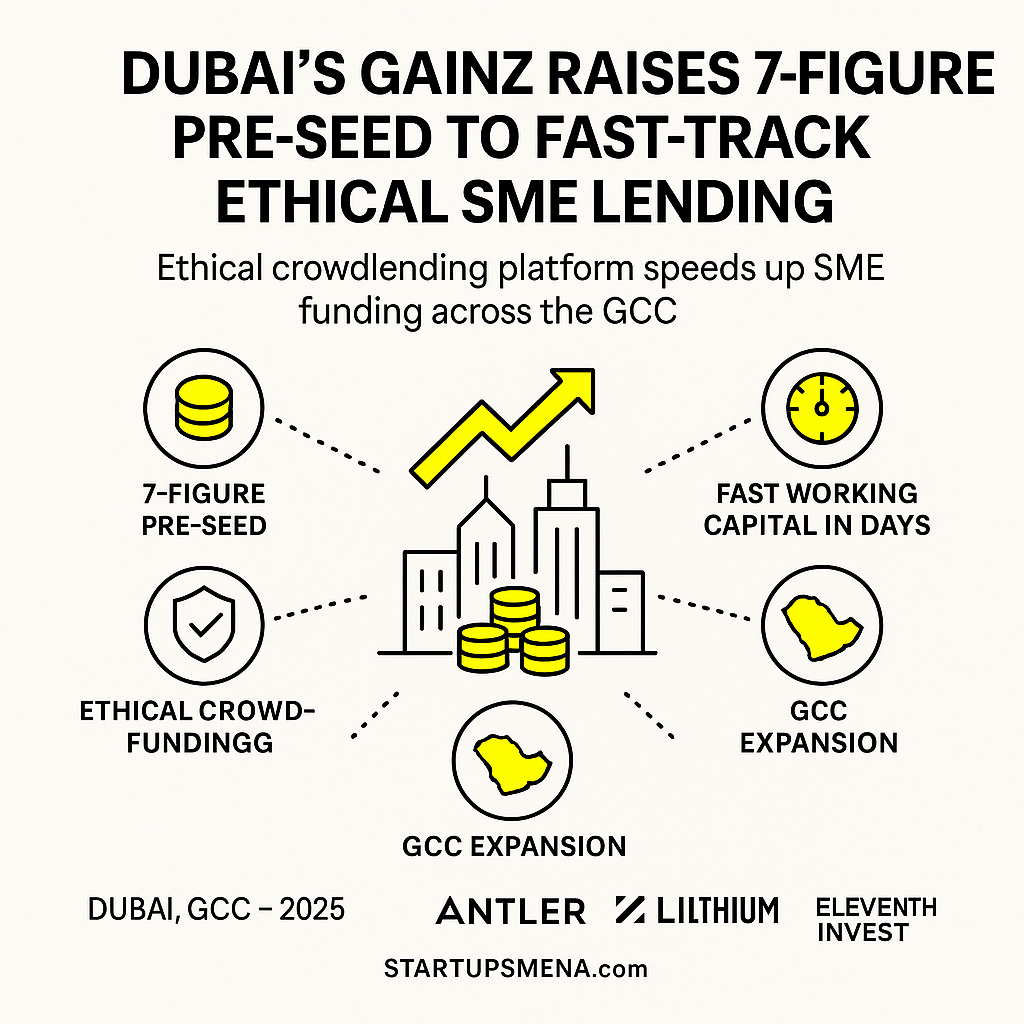
Gainz, a Sharia-compliant crowdlending platform for SMEs, has raised a seven-figure pre-seed round (just over $1 million) in a mix of equity and debt to scale its alternative lending marketplace across the region. The round is led by Antler MENAP, Lithium Holdings and Eleventh Invest Inc., alongside a network of regional high-net-worth investors.
Founded in December 2024 by Egyptian serial entrepreneurs Shehab Mokhtar (CEO) and Sherif Abdelaty (COO), Gainz connects everyday investors with vetted businesses that need working capital, using a fully digital, Sharia-compliant structure.
A New Path to Working Capital for SMEs
Traditional SME lending in MENA is slow and paperwork-heavy. It can take two to four months for businesses to secure approvals, even for short-term working capital—an eternity for companies managing payroll, inventory or receivables.
Gainz flips that journey: SMEs apply online, run through digital verification and, once approved, launch a financing campaign on the platform. Instead of negotiating with a single lender, they tap a crowd of individual and retail investors who fund the campaign in return for fixed-income returns.
The platform’s core promise is speed: businesses can set up a working capital campaign in minutes and, in many cases, access funds within days, not months.
Seven-Figure Backing from Regional and Global Investors
The pre-seed round combines both equity and debt—giving Gainz the capital to build its product while also seeding initial lending capacity on the platform. The investment will be used to:
- Scale the tech platform and underwriting engine
- Expand across the GCC, with a focus on key Gulf markets
- Develop new alternative credit products tailored to SMEs
“It was clear they were a mission-driven team tackling a critical challenge for SMEs across MENA,” said Romain Assuncao, partner at Antler MENAP, which first backed the team during its Riyadh cohort in 2024.
The founders themselves bring more than two decades of experience building, scaling and exiting companies across multiple industries—experience that’s proving vital as they navigate both regulation and SME reality.
How Gainz Works for Investors and Businesses
Gainz positions itself as an AI-enabled, Sharia-compliant private credit marketplace for the GCC.
For SMEs
- Raise working capital in under a week, against specific campaigns
- Avoid equity dilution—no cap tables, no board seats for investors
- Tap a new pool of capital beyond traditional banks
- Benefit from digital onboarding and automated risk assessment
For Individual and Retail Investors
- Invest in vetted SMEs from ticket sizes starting at $500, opening a market that historically skewed towards institutions and family offices
- Access short-tenor, fixed-income opportunities with targeted annual returns in the 7–10% range, according to the platform’s investor materials
- Participate in Sharia-compliant structures that avoid conventional interest and align with Islamic finance principles
“Investment facilitation for individuals and busy professionals has always been an untapped opportunity,” said co-founder and CEO Shehab Mokhtar, explaining why Gainz chose a crowdlending model rather than a purely institutional play.
Early Traction: Seven Deals, $400,000 Deployed
Though still young, Gainz has already tested its model in the market. During its MVP phase in Q2 2025, the platform closed seven SME financing deals, disbursing nearly $400,000 in loans.
Those early campaigns served a dual purpose:
- They validated SME demand for faster, non-dilutive working capital
- They demonstrated investor appetite for short-duration, real-economy debt opportunities
“We’re seeing a surge in SME demand across the Middle East, confirming the size of the gap we’re trying to serve,” the founders said in a joint statement.
Tackling a $200 Billion SME Financing Gap
Across MENA, SMEs account for the majority of businesses and a large share of employment—but they struggle to access credit at scale. Multiple estimates put the regional SME financing gap at around $200 billion or more, particularly in alternative and non-bank lending.
Gainz is positioning itself squarely in that gap, focusing on:
- Working capital campaigns rather than long-term project finance
- AI-powered underwriting, to help assess creditworthiness in markets where credit bureau data can be thin
- Ethical, Sharia-compliant structures, which remain under-served in the SME debt space despite strong demand
By using technology to compress decision times and diversify risk across hundreds of investors, Gainz wants to make SME lending behave more like a digital marketplace than a bank queue.
What Comes Next
With fresh capital in the bank, Gainz plans to:
- Deepen its presence across the GCC, starting from its Dubai base
- Launch new products around invoice and receivables financing
- Build out risk tools and dashboards for both SMEs and investors
- Grow an investor community that sees private credit not as a niche, but as a mainstream asset class
If it succeeds, Gainz will not only give SMEs a faster path to cash—it will also give ordinary people in the region a way to participate directly in the growth of the businesses they see around them.
Editor’s Note — The Startups MENA Team
At Startups MENA, we track the capital flows and technologies that are quietly reshaping how the region’s real economy gets financed. Gainz’s seven-figure pre-seed round is more than another fintech funding announcement—it’s a signal that Sharia-compliant private credit and SME-focused crowdlending are moving from experiment to infrastructure.
By opening up SME lending to individual investors with tickets starting at $500, platforms like Gainz challenge two long-standing assumptions: that meaningful credit must come from banks, and that real-economy debt is reserved for institutions and family offices. Instead, they invite a new class of investor to participate in the region’s growth—not through speculation, but through financing everyday businesses.
As the GCC doubles down on economic diversification and SME development, alternative lending rails will be as important as equity rounds and mega-funds. Stories like Gainz’s mark an emerging chapter in the MENA startup narrative—where closing the SME financing gap isn’t just a policy priority, but a product problem that founders and builders are racing to solve.
— The Startups MENA Editorial Team