At AU Summit, UAE unveils $4.5 bln African clean energy push
UAE commits $4.5 billion for 60 African clean projects Funding announced at AU Summit in Addis Ababa Nearly 666 million Africans lack electricity, World Bank says The United Arab Emirates has committe
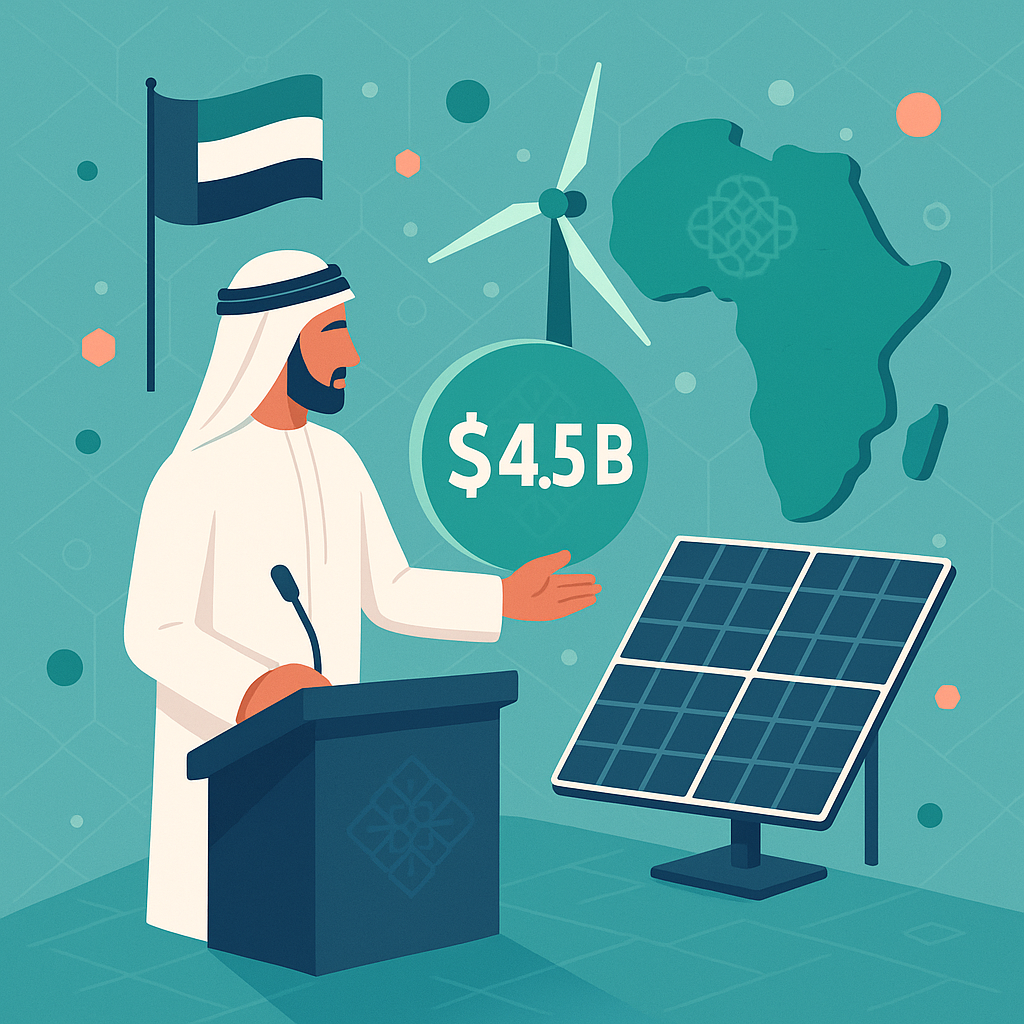
UAE commits $4.5 billion to more than 60 African clean energy projects at AU Summit
The United Arab Emirates unveiled a $4.5 billion financing package to support over 60 clean energy projects across Africa, Sheikh Shakhboot bin Nahyan Al Nahyan, the UAE minister of state for foreign affairs, announced on the sidelines of the 39th African Union Summit held Feb. 14-15, 2026 in Addis Ababa. The funding, launched under the Africa Green Investment Initiative, targets solar, wind, geothermal, battery storage and green hydrogen projects designed to expand electricity generation capacity in several African countries.
"The UAE’s cumulative investments in Africa exceeded $110 billion between 2019 and 2023, with more than $70 billion directed to the energy sector, particularly renewables," Sheikh Shakhboot said, highlighting the Gulf state’s recent footprint on the continent.
The $4.5 billion push complements other UAE-backed programmes cited by the minister. He referred to a separate $10 billion programme led by Masdar, the Abu Dhabi-based renewable energy company, and pointed to the "Etihad 7" initiative, which aims to provide electricity access to up to 100 million people by 2035.
Officials framed the Africa Green Investment Initiative as an acceleration mechanism for projects spanning technologies and geographies. Project types named by UAE authorities include utility-scale solar and wind farms, geothermal developments, battery storage systems to firm intermittent renewables, and green hydrogen production facilities intended to support both domestic and export-oriented energy needs.
- $4.5 billion — committed by the UAE to finance more than 60 clean energy projects across Africa.
- $10 billion — separate programme led by Masdar, cited by the UAE minister.
- $110 billion — UAE’s cumulative investments in Africa between 2019 and 2023, according to Sheikh Shakhboot.
- $70 billion+ — amount the minister said has been directed to the energy sector during 2019–2023.
- Nearly 666 million — number of Africans without electricity, per the World Bank Energy Access Report 2025.
The announcement comes amid persistent financing shortfalls for electrification across sub-Saharan Africa. The World Bank’s Energy Access Report 2025 estimated that nearly 666 million Africans remained without electricity. An International Energy Agency study published in October 2025 found that less than $2.5 billion was mobilized for new electricity connections in the region in 2023, and that nearly $150 billion in cumulative investment — roughly $15 billion a year — will be required by 2035 to achieve universal access.
Observers point to an ongoing imbalance in capital flows: the IEA’s World Energy Investment 2024 report said most African energy spending still favors fossil fuels, while a 2025 Renewable Energy Investment Case for Africa report noted the continent captured about 2% of global clean energy investment in 2024. Still, some segments are growing quickly — the Global Solar Council reported a 42% increase in the photovoltaic market over the year to 2025.
Outlook: The UAE’s $4.5 billion pledge adds a significant pool of capital to Africa’s renewable pipeline and dovetails with Masdar’s $10 billion programme and the Etihad 7 access target. Whether these commitments translate into accelerated grid connections, household electrification and the multibillion-dollar annual investment levels the IEA says are needed will depend on project pipelines, host-country regulation, and additional public and private mobilisation to close the continent’s large electrification gap.
Stay in the loop
Join our weekly newsletter and get the latest MENA startup news, funding rounds, and insights delivered straight to your inbox.