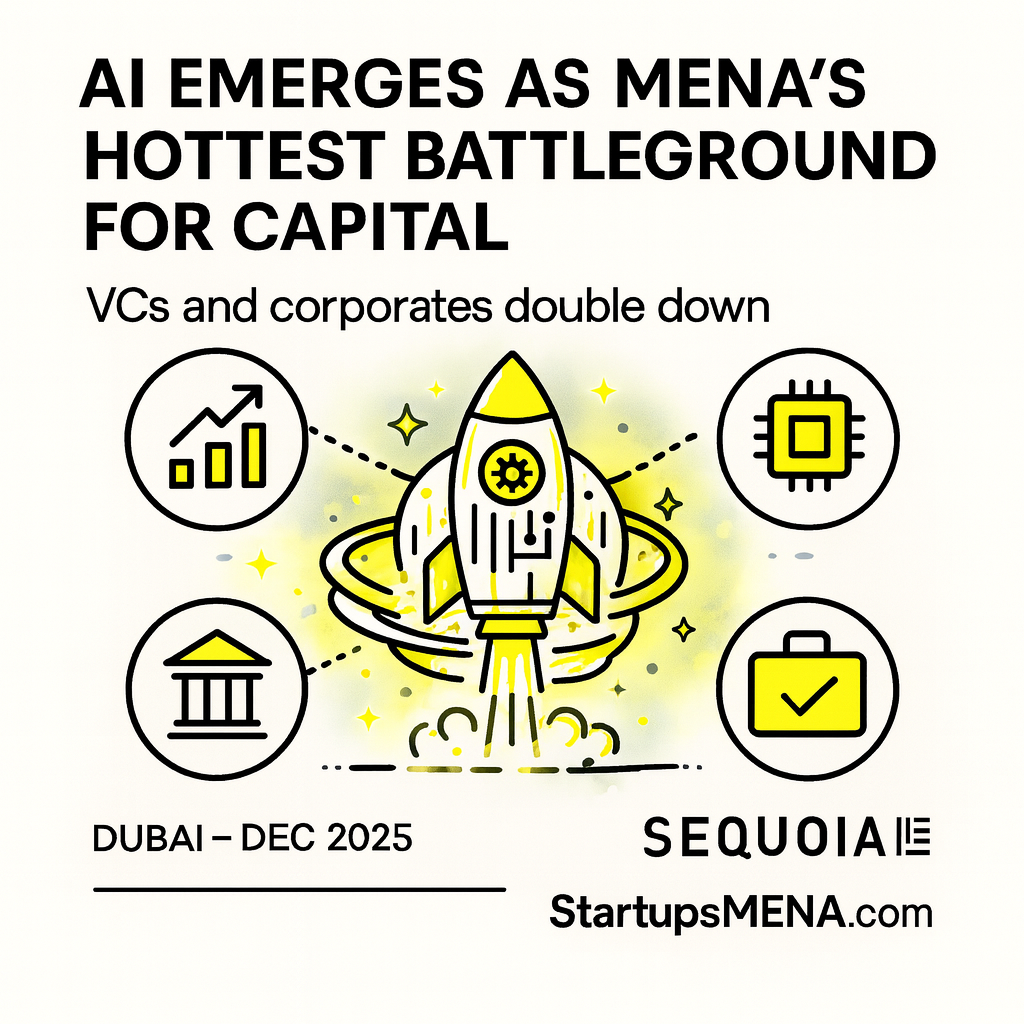
A few years ago, “AI in MENA” mostly meant slide decks and pilot projects. Today, it’s one of the most hotly contested arenas for both venture capital and corporate money — with sovereign funds, global tech giants, regional VCs, and corporate venture arms all racing to stake out positions across the stack.
VC money flows into AI-native startups
AI has quickly moved from “feature” to full-blown investment thesis for regional VCs.
Across the region, AI-focused startups are now among the most closely watched deals in quarterly funding reports. Fintech still takes a large share of capital, but AI is increasingly appearing as a separate category rather than a sub-section of “software”.
On the venture side, several trends stand out:
- Dedicated AI and deep tech funds emerging in the GCC and wider MENA
- Generalist funds treating “AI-native” as a baseline expectation, not a differentiator
- Cross-border syndicates bringing in international AI investors to MENA rounds
At the same time, the bar is rising. Investors are looking for startups where AI is the core engine of the product, not just an add-on. That means:
- Clear AI roadmaps and measurable ROI for customers
- Thought-through data strategy and defensibility
- Capital-efficient models and credible go-to-market plans
Founders pitching “AI” without a strong business case are finding it harder to stand out, even in a hot sector.
Sovereigns and corporates build an AI infrastructure layer
If VCs are funding the applications, governments and corporates are pouring capital into the rails.
Countries across the region have released ambitious national AI strategies aimed at:
- Building data and cloud infrastructure
- Attracting and developing specialized talent
- Embedding AI into priority sectors such as government services, logistics, energy, and healthcare
Large pools of capital in the GCC are now being directed into:
- Data centres and cloud capacity
- High-performance computing and chips
- AI research hubs and applied AI labs
Corporate balance sheets are joining the push. Established players in telecoms, banking, energy, and logistics are:
- Setting up corporate venture capital arms focused on AI and deep tech
- Partnering with AI startups to accelerate internal transformation
- Launching their own AI platforms and solutions for clients
The result is an emerging AI “infrastructure layer” that startups can build on, rather than having to create everything from scratch.
From hype to value creation: how AI is actually being used
AI adoption in the region is shifting from scattered pilots to more scaled, value-driven implementations.
On the corporate side, the most common use cases include:
- Demand forecasting and inventory optimisation in retail and logistics
- Fraud detection and risk scoring in financial services and fintech
- Predictive maintenance and optimisation in energy, utilities, and manufacturing
- Customer service automation using chatbots and agent-assist tools
For startups, AI is becoming the engine behind:
- New fintech and insurtech models
- Healthtech platforms using imaging, triage, and predictive analytics
- Enterprise SaaS for functions like HR, finance, and operations
- Vertical-specific solutions in sectors like logistics, real estate, and mobility
Crucially, boards and leadership teams are now asking a simple question: Where is the value? AI projects are increasingly evaluated on revenue impact, cost savings, and risk reduction — not just on innovation theatre.
What this means for founders and the MENA ecosystem
For founders building in or from the region, AI is now both an opportunity and a filter.
The opportunity
- There is more capital than ever for AI-native plays, from seed to growth stages
- Sovereign funds and corporates are actively looking for AI partners and acquisition targets
- New AI infrastructure, from data centres to national platforms, reduces technical barriers to entry
The most interesting opportunities tend to sit at the intersection of:
- AI + infrastructure: tools that help others use the region’s growing data and compute capacity
- AI + regulated sectors: fintech, health, and public services where local context and regulatory navigation matter
- AI + South–South corridors: platforms that use Gulf hubs to connect markets across Africa, South Asia, and beyond
The filter
At the same time, AI has become a lens through which investors and corporates judge teams:
- Is the AI central to the product or just decorative?
- Does the startup have access to the right data and talent?
- Is there a sustainable edge, or can a larger player replicate it quickly?
Capital is flowing, but it is increasingly targeted at founders who can convert models and infrastructure into real products, real customers, and real cash flows.
Editor’s Note — The Startups MENA Team
AI in the region has clearly moved into its “prove it” phase. Capital is no longer the main bottleneck; credible execution is. Over the next few years, the standout stories won’t just be about who raised the largest AI round, but who built resilient businesses with AI at their core — grounded in real regional problems and real regional demand. That’s where MENA’s next breakout successes are likely to come from.– By The Startups MENA Editorial Desk