A Megadeal Signaling the Next Frontier of Artificial Intelligence
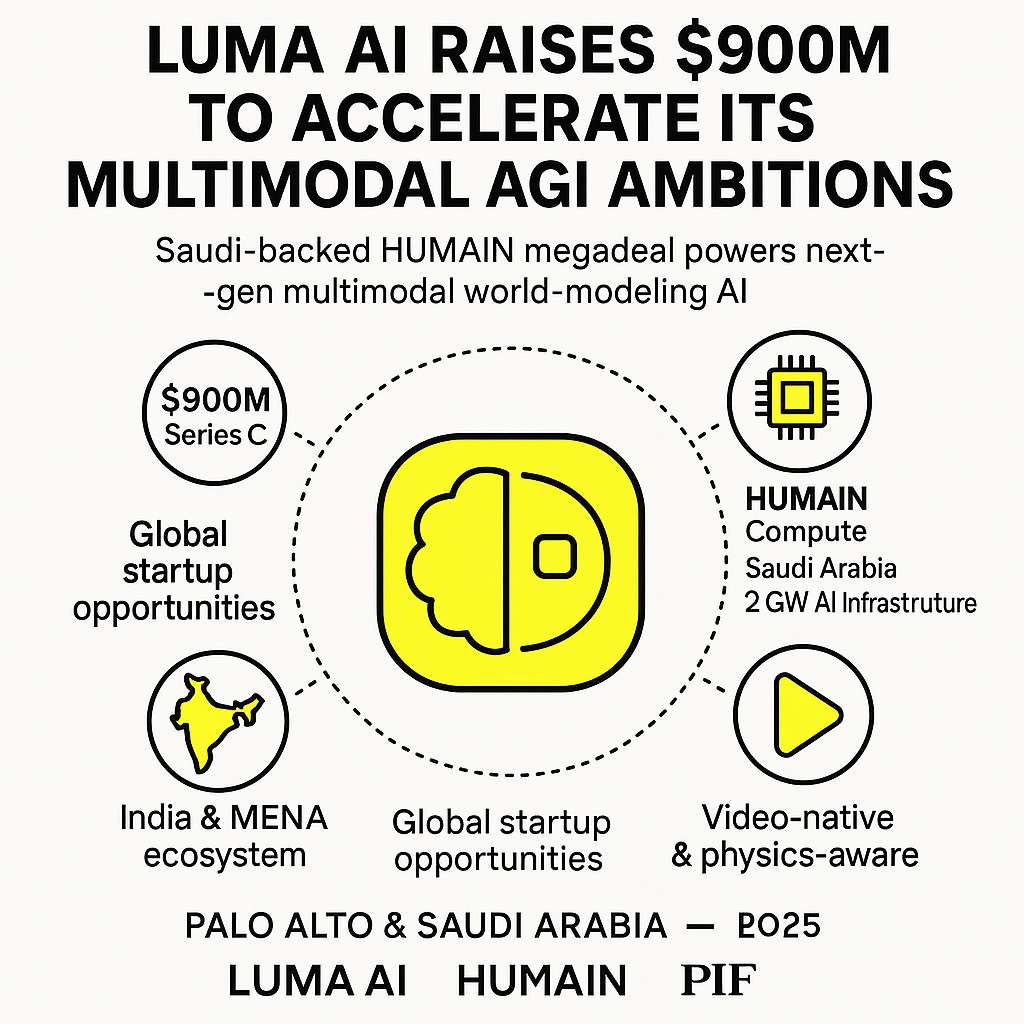
Luma AI, the Palo Alto–based startup known for its breakthroughs in video-native and multimodal generative AI, has raised a landmark $900 million Series C round. The raise is led by HUMAIN, a full-stack AI infrastructure company backed by Saudi Arabia’s Public Investment Fund (PIF), positioning this deal as one of the largest global AI investments of the year.
This capital injection marks a defining moment—not just for Luma, but for the broader shift from text-only large language models (LLMs) to world-modeling AI systems capable of understanding video, image, audio, and real-world context.
Why This Funding Round Matters
More than a financing event, the round is a strategic alliance between:
- Luma AI, which is building next-generation multimodal AGI
- HUMAIN, which is developing one of the world’s most powerful AI compute clusters—scaling toward 2 gigawatts in Saudi Arabia
Together, the collaboration unlocks the infrastructure needed to train models on peta-scale multimodal datasets, far beyond the text-dominant corpora powering today’s LLMs.
This signals three major trends:
- The global shift to multimodal AI—models that understand the world, not just words
- Middle Eastern capital and infrastructure stepping into frontier AI
- Rising investor conviction that the next trillion-dollar AI opportunity lies in video-native and physics-aware intelligence
What Luma AI Plans to Build Next
The new capital will be deployed toward:
1. Scaling Multimodal Training
The HUMAIN partnership gives Luma access to a massive compute footprint—essential to training AI that can simulate, reason, and generate in dynamic visual environments.
2. Expanding Its Flagship Systems
Models like Ray 3 and Dream Machine, already known for photorealistic image/video generation, will now evolve into richer simulation and world-modeling tools.
3. New Applications Across Verticals
Luma is expected to push deeper into:
- Creative workflows and filmmaking
- Robotics and spatial computing
- Simulation for industrial and scientific environments
- Immersive media and digital twins
These are sectors where multimodal AGI outperforms language-only AI.
The Bigger Picture: Why Multimodal AGI Is the New Race
The industry is moving beyond LLMs because text alone doesn’t capture the complexity of the real world.
Multimodal systems can learn:
- Physics and motion from videos
- Spatial reasoning from 3D scenes
- Causality from sequences
- Real-world context that strengthens decision-making
This opens a path to “world models”—AI that can understand environments, predict outcomes, and interact intelligently. Many researchers believe this is the closest practical route toward AGI.
What This Means for India, MENA, and the Global Startup Ecosystem
For India
It raises the bar for homegrown AI companies: global-scale compute partnerships and multimodal datasets are becoming the new standard for frontier AI players.
For the Middle East
HUMAIN’s involvement signals the region’s rise as a global AI infrastructure hub. Saudi Arabia’s compute expansion is drawing AI companies, capital, and talent into the region—creating collaboration opportunities for:
- GenAI startups
- Creative tech
- Robotics
- Enterprise AI platforms
For Global Startups
The message is clear: the next wave of AI winners will be those building for video, world-models, and real-world simulation—not just chat interfaces.
Key Takeaways
- Luma AI’s $900M raise is one of the largest multimodal/AGI-focused rounds of 2025.
- The partnership with HUMAIN gives Luma a rare infrastructure advantage in peta-scale multimodal training.
- Multimodal, world-modeling AI is rapidly overtaking language-only models as the next frontier.
- MENA’s deepening role in global compute infrastructure offers new opportunities for regional and international startups.
- This deal marks a turning point: AGI is shifting from theory to engineering reality.
Editor’s Note — The Startups MENA Team
At Startups MENA, we chronicle the shifts shaping the region’s innovation economy. Luma AI’s $900 million raise is more than another headline in the global AI race—it highlights how the future of intelligence is no longer built in one geography.
The Middle East’s strategic investments in compute infrastructure, multimodal AI, and next-generation research are positioning the region not just as a participant, but as an architect of the world’s AI future. Partnerships like HUMAIN × Luma signal a new phase where frontier technology is co-designed across borders, with the MENA region at the center of capability building.
As the world moves from language models to world-models, the question shifts from who builds AI to who can power it, scale it, and deploy it responsibly. The region is rising to that challenge.
— The Startups MENA Editorial Team