A New Chapter in the Middle East’s AI Infrastructure Race
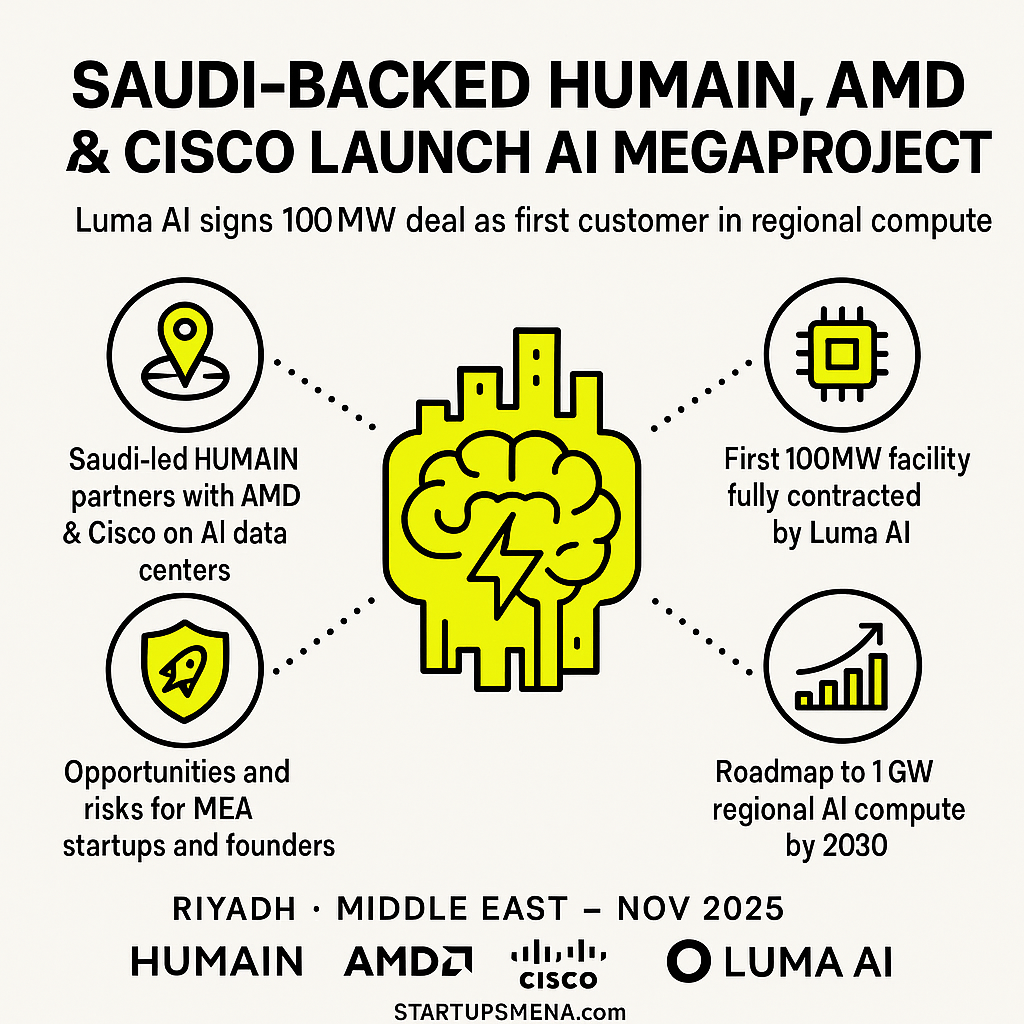
In a move that signals the Middle East’s accelerating ambitions in artificial intelligence, Saudi Arabia’s AI company HUMAIN has launched a major joint venture with AMD and Cisco to build next-generation AI data-centre infrastructure across the region. The venture has already secured its first major customer for a 100-megawatt (MW) data-centre facility—an unusually strong market signal for a project of this scale.
The debut customer is Luma AI, a fast-growing generative-video startup, which has contracted the full capacity of the first site—giving the venture instant credibility and guaranteed utilisation from day one.
A Partnership Built on Clear Strengths
Each partner brings a distinct value to the venture:
- HUMAIN will lead the initiative, developing the site, overseeing construction, and aligning the project with Saudi Arabia’s national AI infrastructure strategy.
- AMD contributes its newest AI chips, including the advanced MI450 line, and takes a minority stake—linking its long-term incentives to the success of the venture.
- Cisco provides the networking backbone and joins AMD as a minority shareholder, with its global salesforce helping distribute regional compute capacity.
This is not a reseller agreement—it’s a shared-risk, shared-profit partnership.
Why This Matters: AI Compute as a Strategic Asset
The project fits into a much larger regional play. Saudi Arabia aims to position itself as a global AI compute hub, leveraging low-cost energy, sovereign investment power, and geographic proximity to a combined market of more than 4.5 billion people across the Middle East, Africa, South Asia and parts of Europe.
A 100 MW site is only the beginning. The partners expect to scale to 1 gigawatt (1,000 MW) of AI data-centre capacity by 2030—placing the region among the most significant emerging players in global compute infrastructure.
This comes on the heels of a previously announced multi-year collaboration between HUMAIN and AMD, valued at up to $10 billion, to deploy large-scale AI compute over the next five years.
Opportunities and Risks Ahead
Opportunities
- Regional AI access: Startups and enterprises across MEA may gain access to compute power traditionally concentrated in the U.S. and Europe.
- Ecosystem boost: A robust compute layer may accelerate AI company formation across the region.
- Global attractiveness: By partnering with U.S. tech leaders, Saudi Arabia positions itself as an open, globally integrated AI hub.
Risks
- Execution complexity: Renewable-energy sourcing, heat management, and construction timelines are major variables.
- Regulatory uncertainty: Global AI geopolitics—including export controls—may influence component availability.
- Utilisation risk: Although the first 100 MW is contracted, sustained customer acquisition across long-term expansion remains critical.
What Startups and Founders Should Watch
- Compute access and pricing: If competitively priced, this could become a meaningful alternative to U.S./EU cloud providers.
- Latency advantages: MEA-based apps, fintechs, and AI-heavy platforms may gain performance benefits from regional hosting.
- Ecosystem openness: The real test will be whether the venture offers startup-friendly access or prioritises large enterprise clients.
Editor’s Note — The Startups MENA Team
At Startups MENA, we focus on the narratives that define how the Middle East builds its next-generation workforce and innovation economy. The UAE’s new initiative to train 10,000 youth and create 30,000 jobs is more than a development program—it’s a blueprint for how a nation future-proofs its human capital.
By merging education, entrepreneurship, and digital innovation through StartupEmirates.ae, this campaign moves beyond traditional job creation. It lays the groundwork for an ecosystem where young Emiratis are not just employees, but founders, builders, and contributors to a self-sustaining economy.
As the UAE continues to accelerate toward Vision 2030 and Centennial 2071, the focus is shifting from dependence on opportunity to the creation of opportunity. This marks a defining chapter in the region’s transformation—where youth empowerment is not a policy goal, but the foundation of economic resilience.
— The Startups MENA Editorial Team