A Landmark Move in Global AI Infrastructure
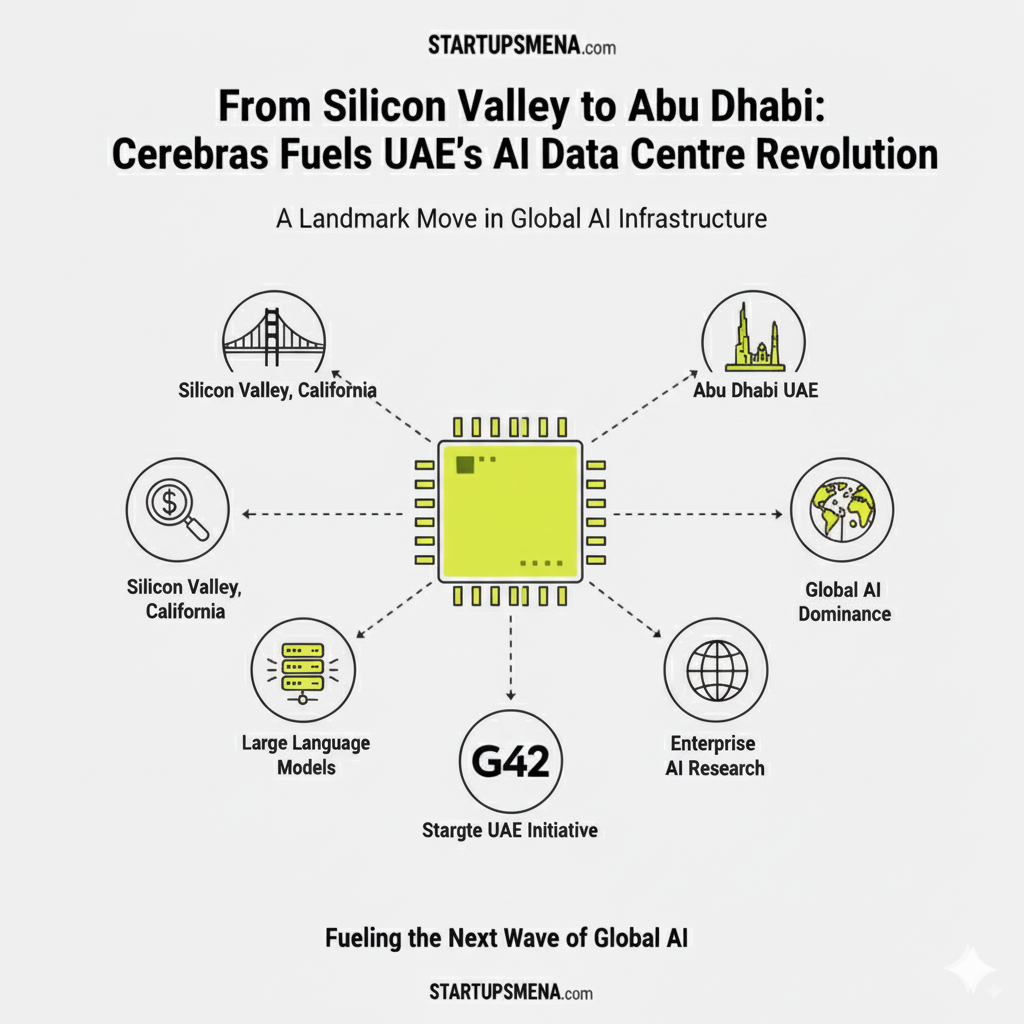
Cerebras Systems, the California-based artificial intelligence chipmaker, has announced plans to deploy large-scale AI infrastructure in the United Arab Emirates (UAE) as part of the ambitious Stargate UAE initiative. The company will deliver “megawatts worth of equipment,” according to CEO Andrew Feldman, marking one of the biggest AI data centre buildouts outside the United States.
The expansion signals both a technological milestone and a geopolitical shift — one where the Middle East emerges as a new axis in the race for global AI dominance.
Inside the Cerebras–Stargate Collaboration
The Stargate UAE project, led by G42 — a major Abu Dhabi-based technology group — aims to create one of the world’s largest and most advanced AI data centre ecosystems.
Cerebras Systems will provide the high-performance computing infrastructure that powers these data clusters, supporting advanced AI workloads such as large language model training and enterprise AI research.
Feldman told Reuters that the company plans to install multiple “big clusters” of its systems in the region, with total capacity reaching several megawatts. Cerebras’s unique wafer-scale engine architecture gives it a significant advantage in high-throughput AI training — an essential capability for the UAE’s growing AI ambitions.
Expanding Beyond Silicon Valley
This move forms part of Cerebras’s broader international expansion. The company currently operates six AI data centre sites worldwide and plans to double or even triple that number — reaching up to 15 sites in the next eight months.
Beyond the UAE, new deployments are expected across India and Pakistan, signalling a concerted push into emerging AI markets.
The company also intends to re-file for an initial public offering (IPO) “shortly” after raising $1.1 billion earlier this year, underscoring the scale of its growth plans.
The UAE’s Vision: Becoming an AI Superpower
For the UAE, this partnership is part of a grander vision. Over the past few years, the country has made sweeping investments in artificial intelligence — from government-backed innovation strategies to partnerships with leading global tech firms like Nvidia, OpenAI, and Microsoft.
The Stargate UAE campus is designed to cement the nation’s status as a global AI hub. Located within Abu Dhabi’s growing technology corridor, it represents a commitment to attracting world-class computing power, research, and talent to the region.
This initiative aligns with the UAE’s National Artificial Intelligence Strategy 2031, which aims to position the nation among the top AI-powered economies in the world.
Why Cerebras Matters in the AI Arms Race
Cerebras Systems is not just another chipmaker. Its flagship Wafer Scale Engine — the largest computer chip ever built — allows unprecedented performance for AI workloads, far exceeding traditional GPU-based systems in specific applications.
By delivering custom-built AI supercomputers instead of relying on commodity GPUs, Cerebras offers governments and enterprises an alternative to Nvidia’s near-monopoly on AI compute.
Deploying these systems in the UAE gives Cerebras both regional presence and strategic leverage — especially as global demand for compute power surges amid the rise of generative AI.
Challenges Ahead: Regulations and Geopolitics
While the announcement is significant, the path ahead is complex. High-performance AI hardware exports require U.S. government approval, particularly when destinations involve sensitive technology ecosystems.
Cerebras’s computers built for G42 are still located in the United States, awaiting export licences. Washington has expressed concerns over technology sharing and G42’s historical ties with Chinese firms, meaning scrutiny will likely remain high.
Beyond export controls, logistical challenges — such as power availability, cooling efficiency, and supply chain resilience — could also affect deployment timelines.
Strategic Implications for the Middle East
If realised, the Cerebras–Stargate collaboration could redefine the Middle East’s technological landscape. By establishing large-scale AI data centres locally, the UAE reduces dependence on foreign cloud infrastructure and creates new opportunities for regional research, enterprise AI, and sovereign data management.
It could also encourage neighbouring countries, including Saudi Arabia and Qatar, to accelerate their own AI infrastructure investments — transforming the Gulf into one of the world’s most important technology corridors.
What Comes Next
Industry observers will be watching closely for:
- Final contract sign-offs between Cerebras and G42.
- Export licence approvals from U.S. authorities.
- Construction updates on the Stargate data centre campus.
- Cerebras’s IPO filing and fundraising outcomes.
If all goes as planned, the first phase of the UAE deployment could go live in 2026 — potentially setting a new benchmark for AI data centre design and performance.
Editor’s Note — From the TechFront MENA Team
At TechFront MENA, we explore the stories redefining the Middle East’s position in the global technology landscape. Cerebras Systems’ planned deployment at the Stargate UAE hub is more than a milestone in AI infrastructure—it’s a signal that the region is no longer just adopting innovation, but architecting it.
The partnership between the U.S.-based chipmaker and Abu Dhabi’s G42 underscores a profound shift: the Gulf is transitioning from being a consumer of advanced technology to becoming a builder of foundational digital ecosystems. “Megawatts” of AI compute power in the desert reflect a new industrial era—one driven not by oil, but by data and intelligence.
As nations across the region race to localize AI capability and attract global partnerships, the UAE’s vision through Stargate sets the tone for what’s next. This is the infrastructure beneath the future—where geopolitics, energy, and computation converge to shape the world’s next technological frontier.
— The TechFront MENA Editorial Team